
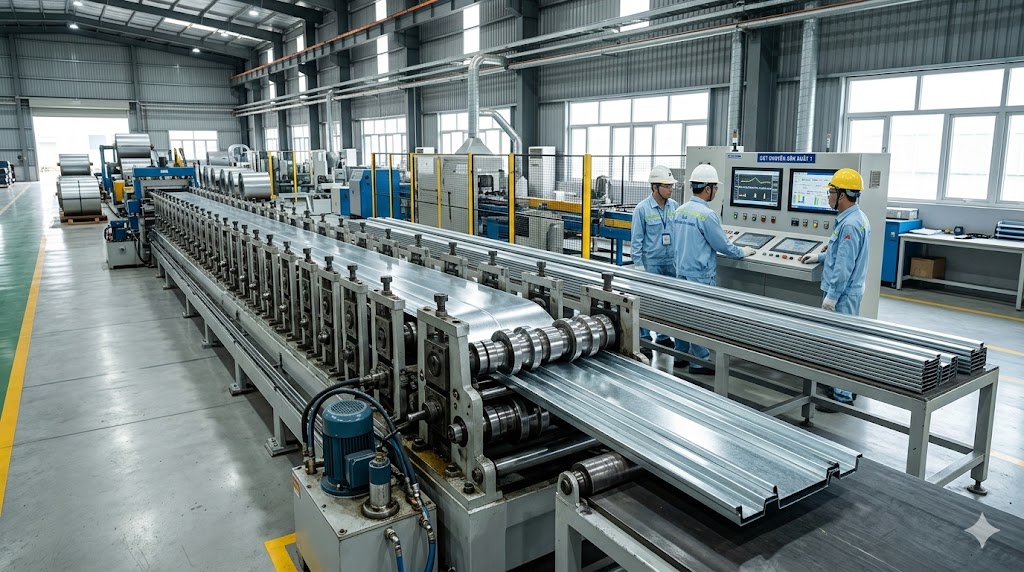
Roll Forming Vietnam has become a strategic manufacturing solution for OEMs requiring continuous, high-volume production of consistent metal profiles. As industries demand dimensional accuracy, structural strength, and cost efficiency, roll forming technology offers a scalable and reliable solution.
Unlike batch forming processes, Roll Forming Vietnam supports continuous production of uniform cross-section profiles. Consequently, manufacturers can achieve high output rates while maintaining tight dimensional tolerances. Moreover, Vietnam’s growing industrial ecosystem enables suppliers to integrate tooling design, automated forming lines, and secondary operations within a coordinated production framework.
Why Roll Forming Vietnam Is Essential for Continuous Production
Roll forming is a continuous bending operation in which sheet metal passes through successive roll stations to achieve a desired cross-section. Because deformation occurs gradually, material stress distribution remains controlled. Therefore, longer profile lengths can be produced with minimal distortion.
Roll Forming Vietnam is particularly suitable for:
- Structural components
- Framing systems
- Rails and tracks
- Reinforcement channels
- Automotive and appliance parts
In addition, continuous processing reduces material waste and shortens production cycles. As a result, manufacturers benefit from improved cost efficiency and repeatability.
Technical Capabilities of Roll Forming Vietnam
Successful roll forming requires precise roll tooling, alignment accuracy, and line stability. Each station progressively shapes the metal to avoid cracking or uneven thickness.
Progressive Roll Tooling Design
Roll tooling determines final profile geometry. Engineers use CAD/CAM software to design roll sequences that gradually form the material without overstressing it.
Because improper roll sequencing may cause distortion, simulation tools are often applied before production begins. Consequently, setup time decreases and dimensional accuracy improves.
Continuous Line Integration
Modern Roll Forming Vietnam facilities operate automated lines with coil feeding systems, straighteners, punching units, and cutoff equipment. This integration enhances production efficiency.
Furthermore, inline inspection systems monitor profile dimensions during operation. If deviations occur, operators can adjust roll pressure and alignment immediately.
Material Versatility
Roll forming accommodates various materials, including mild steel, stainless steel, galvanized steel, and aluminum. Thickness ranges depend on application requirements; however, continuous forming ensures consistent cross-sections regardless of length.
Linear Metal Shapes in Industrial Applications
Many industrial components require uniform cross-sections over extended lengths.
Linear metal shapes
Linear metal shapes such as channels, U-profiles, and rails are efficiently produced through Roll Forming Vietnam technology. Because the process is continuous, profile consistency is maintained across thousands of meters of output.
Additionally, tight dimensional control ensures compatibility with assembly systems in construction and industrial equipment manufacturing.
Custom Steel Profiles for OEM Programs
OEM projects often demand specialized cross-sections tailored to specific structural or mechanical requirements.
Custom steel profiles
Custom steel profiles are developed through dedicated roll tooling configurations designed for precise geometry and structural performance. By adjusting roll stations and forming sequences, manufacturers can achieve complex cross-sections without additional welding or secondary forming.
This flexibility allows Roll Forming Vietnam suppliers to support automotive, appliance, and infrastructure projects with tailored solutions.
Integration Within the Broader Metal Forming Ecosystem
Roll forming is part of a comprehensive manufacturing landscape.
Metal Forming Vietnam
Metal Forming Vietnam encompasses stamping, deep drawing, hydraulic forming, and continuous profile manufacturing. Roll Forming Vietnam operates as a specialized segment within this broader ecosystem, focusing on high-volume linear profile production.
By integrating operations within Metal Forming Vietnam capabilities, OEMs can consolidate suppliers and streamline multi-process production strategies.
Advanced Production Capabilities
High-volume profile manufacturing requires stable automation and process control.
Automated Roll Forming
Automated Roll Forming lines enhance productivity by integrating coil feeding, inline punching, and automated cutoff systems. This automation reduces manual intervention and improves repeatability.
In Vietnam, expanding factory capacity supports scalable output suitable for export-oriented programs.
Structural Roll Forming
Structural Roll Forming focuses on load-bearing components used in construction and infrastructure. Reinforced channels and framing systems require precise geometry to ensure structural stability.
Through advanced roll design and controlled material feed, manufacturers maintain dimensional integrity across heavy-duty applications.
Cold Forming Vietnam
Cold Forming Vietnam refers to room-temperature deformation processes that preserve material properties while enhancing dimensional accuracy. Roll forming, as a cold working method, improves surface finish and structural strength without thermal distortion.
This capability supports precision applications where uniformity and strength are critical.
Quality Control in Roll Forming Vietnam
Consistent profile production depends on disciplined quality management.
In-Process Dimensional Monitoring
Inline gauges measure width, height, and straightness of profiles during operation. Operators monitor roll alignment and pressure distribution to prevent distortion.
Because continuous production amplifies small deviations over long lengths, real-time monitoring is essential. Therefore, corrective action is implemented immediately when necessary.
Final Inspection and Documentation
Before shipment, profiles undergo dimensional verification and surface inspection. When required, material certificates and quality reports accompany export orders.
Structured inspection procedures ensure compliance with international engineering standards.
Commercial Advantages of Roll Forming Vietnam
Cost competitiveness remains an important factor; however, technical reliability and delivery stability are equally critical. Vietnam offers favorable labor structures and expanding industrial infrastructure.
Trade agreements such as CPTPP and EVFTA enhance export efficiency. Moreover, growing logistics networks improve shipping timelines to global markets.
Because tooling development and automation integration are managed locally, project lead times remain predictable. Consequently, buyers can align production schedules with market demand.
Future Outlook of Roll Forming Vietnam
Infrastructure expansion, renewable energy projects, and industrial modernization drive demand for continuous metal profiles. Therefore, roll forming capacity in Vietnam continues to expand.
Investment in automation and digital process monitoring strengthens production stability. As factories adopt Industry 4.0 technologies, dimensional accuracy and efficiency will improve further.
Roll Forming Vietnam is evolving from a cost-based alternative into a technically mature and export-ready manufacturing capability.
Conclusion
Roll Forming Vietnam delivers continuous profile manufacturing solutions designed for high-volume, precision production. Through advanced tooling, automated lines, and integrated quality control systems, Vietnamese manufacturers support industrial and construction OEM programs effectively.
For companies seeking scalable, reliable, and cost-efficient linear profile manufacturing, Vietnam provides a strong technical and commercial foundation within the broader Metal Forming Vietnam ecosystem.