
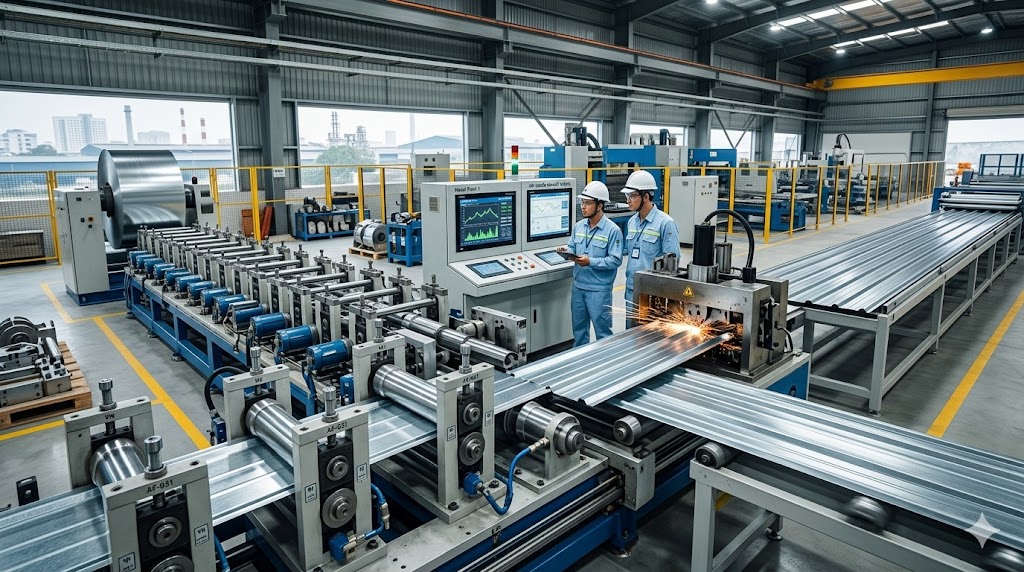
Automated Roll Forming in Vietnam has become a key driver of scalable, high-efficiency profile manufacturing for global OEMs. As industries demand higher throughput, tighter tolerances, and consistent repeatability, automation transforms traditional roll forming into a data-driven, precision-controlled production system.
In today’s competitive manufacturing landscape, Automated Roll Forming integrates coil feeding, progressive roll stations, inline punching, cutting systems, and digital monitoring. Consequently, Vietnamese factories can achieve high-speed production while maintaining dimensional stability across extended profile lengths. Moreover, expanding industrial infrastructure in Vietnam supports export-ready capacity for automotive, construction, and industrial sectors.
Why Automated Roll Forming Enhances Factory Capacity
Traditional roll forming relies heavily on manual setup and mechanical alignment. However, automation significantly improves production efficiency and reduces variability.
Automated Roll Forming systems utilize programmable logic controllers, servo-driven adjustments, and synchronized material feed mechanisms. Therefore, production lines operate continuously with minimal downtime. In addition, digital monitoring tools collect real-time performance data, which allows operators to detect deviations early.
Because automated lines reduce manual intervention, labor costs decrease while output consistency improves. As a result, factory capacity expands without compromising quality standards.
Technical Architecture of Automated Roll Forming Lines
Advanced roll forming lines consist of multiple integrated subsystems that operate in coordination.
Automated Coil Feeding and Straightening
Coil feeding systems manage material flow into the forming line. Precision straighteners remove residual curvature before the material enters roll stations.
By controlling tension and alignment, manufacturers prevent profile distortion at early forming stages. Consequently, downstream roll stations operate with improved stability.
Progressive Roll Stations with Servo Control
Each roll station gradually shapes the metal strip into the final cross-section. Servo-driven adjustments ensure precise pressure application and alignment.
Because deformation occurs progressively, stress distribution remains controlled. Furthermore, automated calibration reduces setup time between product changes.
Inline Punching and Cutoff Systems
Automated Roll Forming lines frequently integrate punching modules for hole creation and slotting. In addition, flying cutoff systems synchronize with line speed to maintain production flow.
This integration eliminates secondary handling and reduces lead time. Therefore, finished profiles exit the line ready for packaging or further assembly.
High-Speed Profiling Capabilities
Modern production programs demand both speed and accuracy.
High-speed profiling
High-speed profiling enables manufacturers to produce continuous metal profiles at elevated line speeds while maintaining dimensional consistency. Advanced servo motors and synchronized drive systems support rapid yet controlled forming operations.
As a result, Automated Roll Forming in Vietnam can meet high-volume export requirements without sacrificing quality performance.
Smart Forming Technology Integration
Automation today extends beyond mechanical motion control. Digital intelligence plays an increasingly important role.
Smart forming tech
Smart forming tech integrates sensors, data analytics, and digital monitoring into roll forming operations. Through real-time parameter tracking, operators can identify variations in pressure, alignment, or material feed.
Consequently, preventive adjustments reduce scrap rates and improve overall equipment effectiveness. Smart systems also support predictive maintenance strategies, which minimize unexpected downtime.
Relationship with Continuous Roll Forming Systems
Automation enhances, rather than replaces, traditional roll forming fundamentals.
Roll Forming Vietnam
Roll Forming Vietnam represents the broader continuous profile manufacturing capability that supports linear metal shapes and structural profiles. Automated Roll Forming builds upon this foundation by adding digital control, servo precision, and integrated monitoring.
By combining Roll Forming Vietnam expertise with automated systems, factories achieve scalable output while maintaining engineering discipline.
Industry Applications of Automated Roll Forming
Automated lines support a wide range of industrial sectors.
Construction and Infrastructure
Construction framing systems require consistent cross-sections and precise hole positioning. Automated lines ensure dimensional uniformity across extended production runs.
Moreover, structural components benefit from high-speed profiling combined with strict tolerance control.
Automotive and Transportation
Automotive manufacturers rely on lightweight yet durable profiles for seat frames, reinforcement rails, and chassis components. Automated Roll Forming ensures repeatable geometry across large production volumes.
Additionally, integrated punching systems enable complex profile designs without secondary machining.
Appliance and Industrial Equipment
Appliance frames and industrial housings demand consistent fit and surface quality. Automated forming technology maintains alignment accuracy, which improves downstream assembly performance.
Quality Assurance in Automated Roll Forming Vietnam
Maintaining consistent output across high-speed lines requires structured quality systems.
Real-Time Monitoring and Feedback Loops
Sensors measure profile dimensions and alignment during operation. Data is transmitted to control systems for immediate analysis.
If deviations are detected, adjustments can be made without halting production. Therefore, batch-to-batch variation remains minimal.
Final Inspection and Documentation
Before shipment, profiles undergo dimensional verification and visual inspection. When required, quality reports and material certificates accompany export orders.
This disciplined approach supports international compliance standards and strengthens OEM partnerships.
Commercial Advantages of Automated Roll Forming Vietnam
Factory automation significantly increases throughput capacity. However, cost efficiency alone does not define competitive strength.
Vietnam benefits from expanding industrial zones, skilled engineering labor, and favorable trade agreements. Consequently, manufacturers can offer scalable production with predictable delivery timelines.
Furthermore, automation reduces human error and shortens setup cycles. As a result, clients experience reliable production continuity even during product changeovers.
Future Outlook of Automated Roll Forming in Vietnam
Industry 4.0 adoption continues to reshape metal forming operations. Digital twins, advanced analytics, and predictive maintenance tools are becoming more widespread.
As automation investment increases, Vietnamese factories strengthen their position in global supply chains. Automated Roll Forming is therefore evolving into a technically mature, export-ready manufacturing capability.
Conclusion
Automated Roll Forming in Vietnam delivers high-speed profiling, smart forming technology integration, and scalable factory capacity for global OEM programs. Through servo-driven roll stations, integrated punching systems, and real-time monitoring, manufacturers achieve consistent dimensional accuracy and production efficiency.
For companies seeking reliable, high-volume linear profile manufacturing supported by digital precision, Vietnam offers a competitive and technically advanced solution within the broader Roll Forming Vietnam ecosystem.