
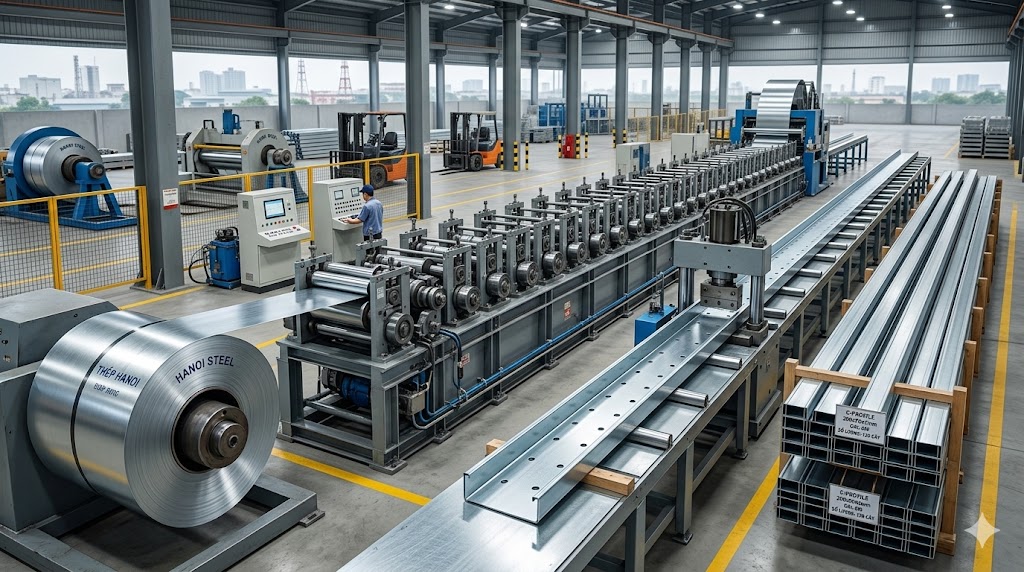
Structural Roll Forming in Vietnam plays a critical role in modern construction and infrastructure development. As building standards rise and project timelines tighten, developers and EPC contractors require consistent, high-strength steel profiles manufactured at scale. Through continuous forming technology, Vietnamese factories deliver structural components with dimensional accuracy and reliable surface protection.
In 2026, demand for prefabricated steel systems, modular construction frameworks, and galvanized support structures continues to grow. Consequently, Structural Roll Forming has become a preferred solution for producing C-channels, framing systems, purlins, and reinforcement members. Moreover, Vietnam’s expanding industrial base enables manufacturers to combine competitive cost structures with export-grade quality control.
Why Structural Roll Forming Is Essential for Construction Projects
Structural steel components must maintain uniform cross-sections, predictable load-bearing capacity, and long-term durability. Unlike traditional fabrication methods that rely on cutting and welding, roll forming produces continuous profiles through progressive deformation.
Because forming occurs gradually across multiple roll stations, material stress is distributed evenly. Therefore, finished profiles exhibit improved straightness and dimensional stability. In addition, high-volume production reduces per-unit cost while ensuring consistency across large construction programs.
Structural Roll Forming is particularly valuable for:
- Industrial warehouse framing
- Commercial building support systems
- Roofing and wall structures
- Solar mounting frameworks
- Infrastructure reinforcement components
As global contractors seek scalable supply partners, Vietnam’s roll forming capacity continues to expand.
Technical Capabilities in Structural Roll Forming
Advanced production lines integrate coil feeding, straightening, roll stations, punching modules, and automated cutoff systems. Each stage contributes to dimensional precision and repeatability.
Progressive Roll Design and Load Distribution
Roll tooling determines final cross-section geometry. Engineers design roll passes to gradually shape steel strips into structural profiles without overstressing the material.
Simulation software evaluates deformation behavior before production begins. Consequently, manufacturers minimize distortion and maintain consistent thickness distribution.
High-Strength Material Processing
Structural steel often involves higher tensile grades to meet load-bearing requirements. Therefore, roll alignment and pressure calibration must be carefully controlled.
By adjusting roll pressure incrementally, factories maintain profile integrity even at higher material strengths. Furthermore, inline measurement systems monitor straightness and dimensional tolerances in real time.
Integrated Punching and Cutting
Construction profiles frequently require pre-punched holes for assembly efficiency. Automated punching systems synchronize with line speed, ensuring accurate hole placement.
Flying cutoff mechanisms maintain continuous flow while achieving precise length control. As a result, structural components exit production ready for packaging and shipment.
C-Channel Production for Framing Systems
C-channels represent one of the most widely used structural profiles in construction.
C-channel production
C-channel production through Structural Roll Forming ensures consistent web thickness, flange alignment, and dimensional uniformity across long lengths. Because the process operates continuously, profile geometry remains stable even in high-volume output.
This manufacturing efficiency supports modular construction systems and reduces on-site fabrication requirements.
Galvanized Profiles for Corrosion Protection
Durability is a key factor in structural applications, especially in humid or coastal environments.
Galvanized profiles
Galvanized profiles produced via Structural Roll Forming offer enhanced corrosion resistance and extended service life. Zinc-coated steel protects structural components from oxidation and environmental exposure.
By combining roll forming precision with galvanizing processes, manufacturers deliver profiles suitable for roofing systems, exterior framing, and infrastructure projects.
Integration Within Continuous Profile Manufacturing
Structural roll forming operates within a broader profile manufacturing ecosystem.
Roll Forming Vietnam
Roll Forming Vietnam represents the comprehensive continuous profile manufacturing capability across industrial sectors. Structural Roll Forming functions as a specialized segment within this ecosystem, focused specifically on load-bearing construction components.
Through integration with Roll Forming Vietnam expertise, OEMs and contractors gain access to scalable production capacity and consistent quality standards.
Quality Assurance for Construction-Grade Steel
Structural applications demand strict adherence to engineering specifications. Without rigorous inspection, load-bearing components may compromise project safety.
In-Process Monitoring
Inline measurement systems verify profile dimensions during production. Operators monitor roll alignment, material feed, and hole positioning accuracy.
Because structural components often require tight tolerances, real-time adjustments are essential. Therefore, deviation is minimized across extended production runs.
Final Inspection and Documentation
Before shipment, finished profiles undergo dimensional verification and surface inspection. Material certificates and coating documentation are provided when required.
These procedures support compliance with international construction standards and facilitate export approvals.
Commercial Advantages for Contractors and Developers
Construction timelines are often compressed, making supply reliability critical. Structural Roll Forming in Vietnam offers predictable production capacity and scalable output.
Vietnam benefits from favorable trade agreements and expanding industrial infrastructure. Consequently, export logistics to North America, Europe, and regional markets remain efficient.
Furthermore, local engineering teams can adapt tooling for customized cross-sections. As a result, project-specific profile requirements are addressed without extended lead times.
Future Outlook of Structural Roll Forming in 2026
Global construction activity is shifting toward prefabrication and modular building systems. Therefore, demand for standardized steel profiles will continue to increase.
Investment in automation and digital monitoring enhances production stability. In addition, sustainable construction practices encourage the use of galvanized and recyclable steel materials.
Structural Roll Forming in Vietnam is positioned to support large-scale infrastructure expansion while maintaining export competitiveness.
Conclusion
Structural Roll Forming in Vietnam delivers reliable, high-volume production of C-channels, galvanized profiles, and load-bearing steel components for construction projects in 2026. Through progressive roll tooling, automated punching systems, and integrated quality control, manufacturers ensure dimensional precision and structural integrity.
For contractors and OEMs seeking scalable supply, consistent profile geometry, and corrosion-resistant steel solutions, Vietnam offers a technically capable and commercially competitive manufacturing partner within the broader Roll Forming Vietnam ecosystem.