
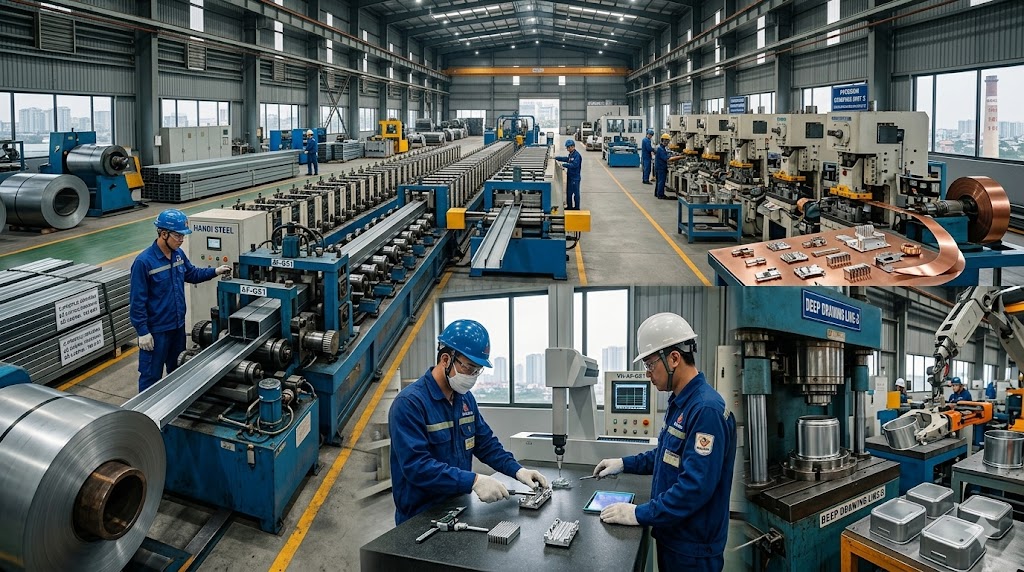
Metal Forming Applications in Vietnam have expanded rapidly across global supply chains, supporting B2B manufacturing programs that demand precision, scalability, and industry-specific parts. As multinational OEMs diversify sourcing strategies, Vietnam has emerged as a technically capable and commercially competitive hub for industrial metal forming.
From automotive chassis components to electronics housings and aerospace-grade parts, Metal Forming Applications now serve high-value sectors with strict compliance requirements. Moreover, local manufacturers combine engineering expertise with export-ready quality systems, enabling buyers to integrate Vietnam into long-term sourcing strategies.
As supply chains evolve in 2026, understanding how metal forming technologies apply across industries becomes essential for procurement managers and technical teams alike.
The Strategic Role of Metal Forming Applications in B2B Manufacturing
In modern B2B manufacturing, suppliers must provide more than capacity. They must deliver process stability, repeatability, and engineering collaboration.
Metal Forming Applications cover multiple technologies, including stamping, roll forming, deep drawing, and cold forming. Each process serves distinct functional requirements. Therefore, selecting the appropriate forming method depends on material type, geometry complexity, and mechanical performance targets.
Vietnam’s industrial ecosystem integrates tooling development, automation, and inline inspection systems. Consequently, buyers gain access to industry-specific parts that meet international tolerance standards.
Key Advantages for Global Buyers
Several factors strengthen Vietnam’s position in industrial metal forming:
- Competitive production costs
- Skilled engineering workforce
- Modernized factory infrastructure
- Export documentation compliance
- Flexibility for mid-to-high volume programs
Because procurement teams increasingly prioritize supply chain resilience, Vietnam offers a balanced alternative to traditional manufacturing regions.
Automotive Sector Applications
The automotive industry demands high-strength, lightweight, and dimensionally precise components.
Automotive Metal Forming
Automotive Metal Forming in Vietnam supports Tier 1 sourcing strategies through production of brackets, structural reinforcements, seat components, and chassis-related profiles. Manufacturers apply stamping and roll forming technologies to achieve tight tolerances and consistent mechanical performance.
Additionally, process validation procedures ensure repeatability across large production volumes, which is critical for automotive supply chains.
Structural Reinforcements and Chassis Parts
Roll formed rails and stamped reinforcements improve vehicle rigidity while maintaining weight efficiency. Engineering teams optimize material grades to meet crash safety standards without unnecessary mass.
Supply Chain Integration
Automotive suppliers require synchronized logistics and quality traceability. Vietnamese factories increasingly adopt digital production tracking to support OEM audit requirements.
Electronics and Precision Tech Components
Miniaturization and precision define the electronics sector.
Electronics Metal Forming
Electronics Metal Forming enables production of precision tech components such as enclosures, shielding cases, and connector brackets. Through deep drawing and fine stamping, manufacturers maintain tight dimensional control and smooth surface finishes.
Because electronic assemblies require precise fitment, forming accuracy directly impacts product reliability.
Thin-Gauge Material Processing
Electronics components often utilize thin stainless steel or aluminum sheets. Controlled forming pressure prevents distortion and preserves surface integrity.
Surface Finishing and Assembly Compatibility
Secondary processes such as coating or anodizing enhance corrosion resistance and aesthetic quality. As a result, formed parts integrate seamlessly into final assemblies.
Aerospace and Medical Critical Components
Certain sectors require elevated compliance standards and stringent inspection protocols.
Critical Metal Forming
Critical Metal Forming addresses aerospace and medical applications where material traceability, dimensional precision, and structural integrity are non-negotiable. Vietnamese manufacturers apply advanced forming techniques and inspection systems to meet export and regulatory requirements.
In aerospace applications, formed brackets and structural supports must withstand demanding operational environments. Meanwhile, medical device components require precise geometry and biocompatible material handling.
Documentation and Compliance
Traceability documentation accompanies production batches to support international certification frameworks. Consequently, buyers gain transparency across the supply chain.
Quality Assurance Systems
Factories serving critical sectors implement multi-stage inspection and material verification. This approach minimizes risk while ensuring consistent product performance.
Cross-Industry Case Studies of Metal Forming Applications
Case studies highlight how Vietnam’s metal forming expertise adapts to varied industrial requirements.
In automotive projects, manufacturers developed customized roll forming lines to meet high-strength steel specifications. By optimizing tooling design, they achieved stable profile geometry and reduced scrap rates.
Within electronics programs, precision stamping lines produced high-volume enclosure components with consistent hole alignment. Inline measurement systems prevented dimensional drift during extended runs.
For aerospace-related applications, controlled forming sequences ensured minimal stress concentration, preserving structural integrity.
These examples demonstrate how Metal Forming Applications adapt to sector-specific demands while maintaining commercial competitiveness.
Industry-Specific Parts and Engineering Collaboration
Producing industry-specific parts requires close coordination between supplier and client engineering teams.
Design-for-manufacturing reviews identify potential geometry adjustments that enhance forming efficiency. Furthermore, simulation tools evaluate stress distribution before tooling fabrication begins.
As a result, product development cycles shorten while tooling optimization improves first-run yield. This collaborative approach supports faster time-to-market for global OEMs.
Vietnam’s Position in 2026 Industrial Manufacturing
Industrial expansion and foreign direct investment continue to strengthen Vietnam’s manufacturing base. Infrastructure improvements support efficient export logistics, while technical training programs elevate workforce capability.
Metal Forming Applications benefit directly from these developments. Automation upgrades and digital monitoring systems enhance consistency across production lines.
Additionally, sustainability considerations encourage energy-efficient forming technologies. Because metal forming often requires less material waste than alternative fabrication methods, environmental impact remains manageable.
Conclusion
Metal Forming Applications in Vietnam serve diverse industries through adaptable technologies, engineering collaboration, and export-ready quality systems. From automotive sourcing to electronics precision and aerospace-critical components, manufacturers deliver industry-specific parts aligned with global standards.
For B2B manufacturing partners seeking scalable capacity and technical reliability, Vietnam offers a strategically positioned industrial ecosystem. As supply chains evolve in 2026, Metal Forming Applications continue to support cross-sector growth with precision, flexibility, and commercial efficiency.