
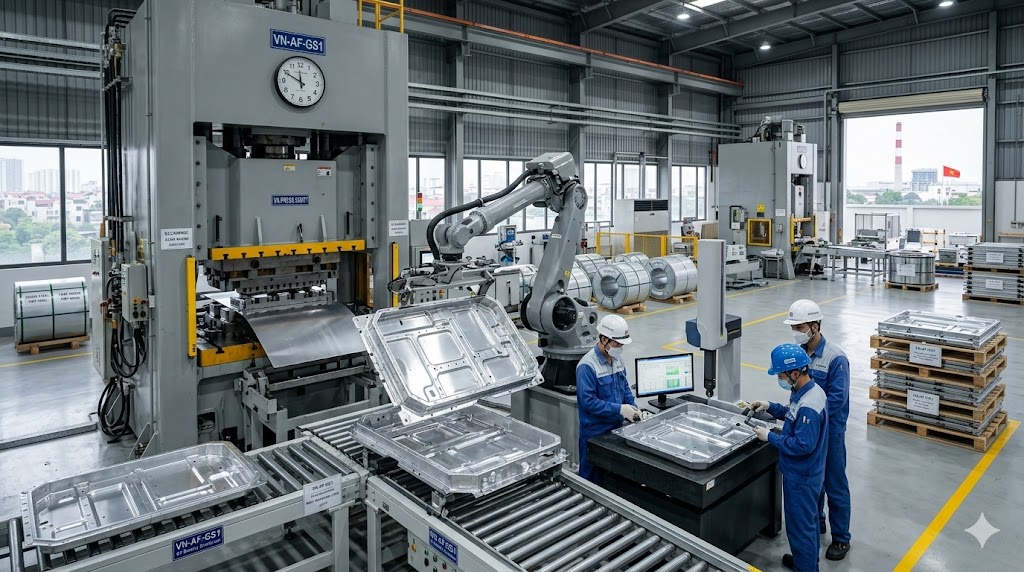
EV Stamping Vietnam has become a critical capability within the global electric vehicle supply chain. As OEMs accelerate electrification strategies, demand for precision battery enclosure components continues to rise. Manufacturers in Vietnam now provide high-accuracy stamping solutions tailored to battery tray forming and lightweight EV parts, meeting both structural and thermal performance requirements.
Electric vehicle battery systems require enclosures that combine dimensional stability, impact resistance, and weight efficiency. Therefore, EV Stamping Vietnam integrates advanced tooling design, controlled forming sequences, and strict quality inspection systems. This approach ensures consistent production performance across mid- and high-volume programs.
In the current automotive landscape, suppliers must deliver scalable output without compromising compliance or traceability. Consequently, Vietnam has positioned itself as a competitive manufacturing base for EV battery enclosure stamping.
Technical Overview of EV Stamping Vietnam
Battery enclosures differ from conventional automotive panels. They must protect high-voltage modules while supporting structural loads and thermal management systems.
EV Stamping Vietnam utilizes progressive dies, transfer presses, and robotic handling systems to produce large-format stamped panels. Through optimized press tonnage and tooling geometry, manufacturers maintain uniform thickness distribution across enclosure surfaces.
Because battery housings often involve aluminum or high-strength steel, forming parameters must be carefully calibrated. Excessive deformation may introduce stress concentration, while insufficient forming pressure can reduce structural integrity. Therefore, controlled stamping processes are essential for achieving consistent enclosure geometry.
Material Selection and Structural Considerations
Electric vehicle battery trays commonly use aluminum alloys for weight reduction. However, certain designs incorporate advanced high-strength steel to enhance rigidity.
During EV Stamping Vietnam operations, engineers evaluate forming simulation data to optimize material flow. As a result, manufacturers reduce wrinkling, tearing, and dimensional variation.
Large-Format Press Capability
Battery enclosures require larger stamping beds than many traditional automotive parts. Vietnamese facilities increasingly invest in high-tonnage presses capable of handling wide sheet formats.
This expansion supports global EV programs that require scalable enclosure production.
Battery Tray Forming for Structural Stability
The battery tray forms the foundation of the battery pack assembly.
Battery tray forming
Battery tray forming in EV Stamping Vietnam involves shaping structural panels that support module integration and vibration resistance. Precision tooling ensures consistent flange geometry and accurate mounting points.
Because trays must align with sealing systems and cooling channels, dimensional tolerance control remains critical throughout the stamping cycle.
Impact Resistance and Safety
Battery trays must absorb impact energy during collisions. Engineers therefore optimize rib structures and reinforcement zones within the stamping design.
Thermal Integration
Formed trays often incorporate cooling channel interfaces. Proper stamping accuracy supports thermal management efficiency and long-term battery performance.
Lightweight EV Parts for Efficiency Targets
Weight reduction directly influences driving range and energy efficiency.
Lightweight EV parts
Lightweight EV parts produced through EV Stamping Vietnam reduce overall vehicle mass without sacrificing structural performance. Aluminum stamping and optimized geometry enable thinner sections with maintained rigidity.
By balancing material selection and forming precision, suppliers contribute to improved energy efficiency across electric vehicle platforms.
Design for Lightweighting
Engineers apply design-for-manufacturing principles to eliminate unnecessary mass. Finite element analysis validates structural behavior before tooling fabrication.
Surface Finish and Assembly Compatibility
Stamped enclosure components must interface seamlessly with sealing gaskets and mounting hardware. Clean surface finishes and burr control ensure proper assembly integration.
Integration Within Automotive Metal Forming Ecosystem
EV battery enclosure production operates within a broader automotive framework.
Automotive Metal Forming in Vietnam provides the foundational infrastructure supporting EV Stamping Vietnam operations. This ecosystem includes stamping lines, quality management systems, and Tier 1 sourcing capabilities.
Through integration with Automotive Metal Forming expertise, manufacturers maintain compliance with global automotive standards and streamline production coordination.
Quality Control and Compliance
Electric vehicle components demand stringent inspection protocols. Manufacturers implement layered quality control procedures, including:
- Incoming material verification
- Inline dimensional monitoring
- Tool wear inspection
- Final geometry measurement
- Batch traceability documentation
Statistical process control minimizes variability across production runs. Additionally, digital inspection systems provide real-time feedback for process adjustments.
Scalability for Global EV Programs
As EV adoption accelerates, suppliers must scale production capacity quickly. Vietnam’s expanding industrial zones support this growth through modern press lines and automation investment.
Flexible tooling adaptation enables manufacturers to support multiple battery enclosure designs. Consequently, EV Stamping Vietnam facilities can manage diverse program requirements simultaneously.
Furthermore, localized supply networks reduce lead times for raw materials and auxiliary components. This operational efficiency supports global OEM sourcing strategies.
Commercial Advantages for BOFU Buyers
Transactional buyers evaluate suppliers based on capability, compliance, and delivery reliability. EV Stamping Vietnam offers competitive cost structures combined with export-grade documentation.
Vietnam’s trade agreements and logistics infrastructure facilitate international shipment. Moreover, engineering collaboration during early project phases reduces development risk and accelerates time-to-market.
Because battery enclosure stamping represents a high-value component segment, technical precision and process validation remain decisive factors. Vietnamese suppliers increasingly align production systems with global EV quality benchmarks.
Future Outlook of EV Stamping in 2026
Electric vehicle production volumes are projected to grow significantly in 2026 and beyond. Battery pack architecture continues to evolve, emphasizing structural integration and weight optimization.
EV Stamping Vietnam adapts to these trends through automation upgrades, tooling innovation, and digital process monitoring. Sustainable manufacturing practices, including scrap reduction and energy-efficient equipment, further enhance competitiveness.
As global OEMs diversify sourcing strategies, Vietnam remains well-positioned to support long-term electrification programs.
Conclusion
EV Stamping Vietnam delivers precision battery tray forming and lightweight EV parts for modern electric vehicle platforms. Through advanced stamping technology, controlled material flow, and integrated Automotive Metal Forming infrastructure, manufacturers provide scalable and compliant enclosure production.
For procurement teams seeking reliable BOFU suppliers, Vietnam offers a technically capable and commercially competitive solution within the evolving EV supply chain landscape.