
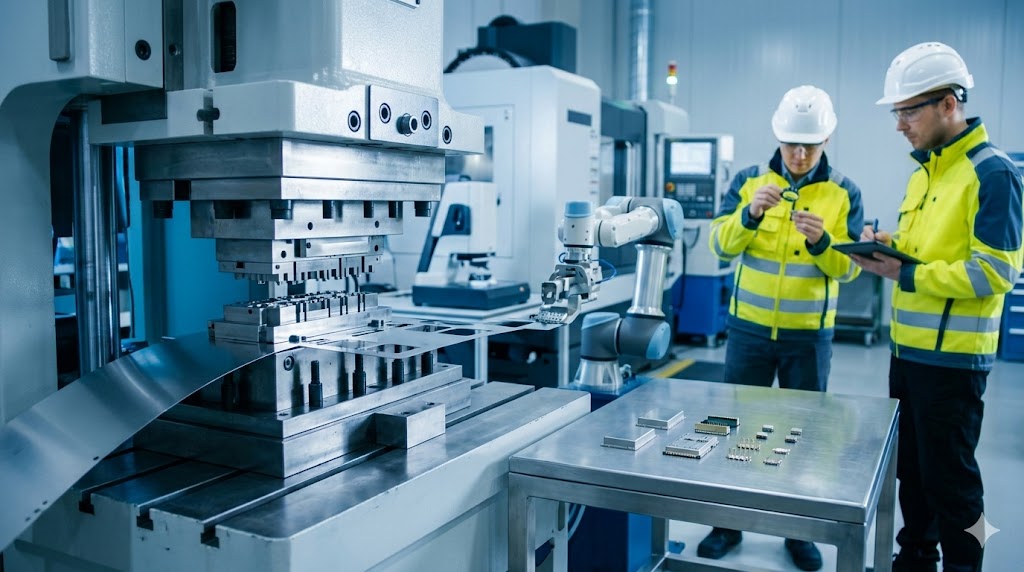
Electronics Metal Forming in Vietnam has rapidly evolved into a strategic solution for global OEMs seeking precision, scalability, and cost efficiency. As electronic devices become more compact and performance-driven, manufacturers require tighter tolerances, higher conductivity, and superior shielding performance. Vietnam’s industrial ecosystem now supports these requirements through advanced stamping, forming, and secondary finishing technologies tailored to high-tech industries.
Today, international buyers in telecommunications, consumer electronics, automotive electronics, and semiconductor sectors increasingly evaluate Vietnam as a mid-to-bottom-of-funnel sourcing destination. Competitive labor costs, expanding technical expertise, and strong export infrastructure position the country as a reliable manufacturing hub for complex electronic metal components.
Electronics Metal Forming Capabilities in Vietnam
Electronics Metal Forming in Vietnam includes precision stamping, progressive die forming, deep drawing, fine blanking, and multi-slide forming. These processes support the production of thin-gauge, high-tolerance components used in sensitive electronic assemblies.
Manufacturers typically work with materials such as:
- Stainless steel (SUS 301, SUS 304)
- Phosphor bronze
- Beryllium copper
- Aluminum alloys
- Nickel silver
Because electronic components require strict dimensional stability, factories integrate CNC tooling, high-speed presses, and automated inspection systems. As a result, they maintain micron-level tolerances and consistent repeatability in high-volume production runs.
Moreover, many Vietnamese facilities now operate under ISO 9001 and ISO 14001 standards. For electronics-specific compliance, selected suppliers also align with RoHS and REACH regulations to meet US and EU market requirements.
Key Applications of Electronics Metal Forming
Electronics Metal Forming supports a wide spectrum of precision components across multiple industries.
Semiconductor and PCB Assemblies
High-frequency systems demand effective shielding and thermal management. Formed metal enclosures, clips, and shielding covers protect sensitive circuits from interference while maintaining structural integrity.
Consumer Electronics
Smartphones, laptops, and wearable devices rely on ultra-thin formed metal parts. These components must balance weight reduction with mechanical strength. Therefore, manufacturers optimize forming parameters to prevent micro-cracks and warping.
Automotive Electronics
Modern vehicles integrate advanced driver assistance systems, infotainment modules, and power control units. Each module requires precisely formed connectors, terminals, and shielding components capable of withstanding vibration and thermal cycling.
Precision Engineering for Semiconductor shields
Semiconductor shields play a critical role in preventing electromagnetic interference within advanced chipsets and communication modules. Because signal integrity directly impacts device performance, shield geometry and surface finishing must meet exact specifications.
Vietnamese manufacturers produce stamped and formed shielding cans, covers, and grounding components using progressive dies and precision bending tools. In addition, automated optical inspection ensures dimensional accuracy before final assembly.
As semiconductor packaging becomes more compact, the demand for thinner materials and tighter bends increases. Consequently, tooling design and material selection become strategic decisions during project planning.
High-Accuracy Production of Micro-stamped parts
Micro-stamped parts are essential in connectors, battery contacts, and miniature electronic assemblies. These parts often measure less than a few millimeters and require extreme precision.
Vietnam’s Electronics Metal Forming suppliers increasingly invest in high-speed presses capable of producing thousands of strokes per minute. This capability supports mass production without sacrificing dimensional consistency.
Furthermore, secondary processes such as plating, deburring, and laser welding enhance product performance. Gold, tin, or nickel plating improves conductivity and corrosion resistance, particularly in harsh operating environments.
Quality Control and Compliance Framework
Electronics Metal Forming projects demand zero-defect tolerance. For this reason, leading Vietnamese manufacturers implement multi-stage quality control systems.
Incoming material inspection verifies alloy composition and thickness. During production, inline sensors monitor press force and alignment. After stamping, coordinate measuring machines and vision inspection systems confirm dimensional compliance.
In addition, traceability systems allow buyers to track batches through production and export stages. This transparency strengthens supply chain confidence for multinational electronics brands.
Vietnam’s Competitive Advantages in Electronics Metal Forming
Several structural advantages make Vietnam attractive for electronics-focused metal forming projects.
First, cost competitiveness remains strong compared to China and other mature manufacturing markets. Although wages have gradually increased, operational expenses still allow global buyers to optimize total landed cost.
Second, Vietnam benefits from strategic trade agreements such as CPTPP and EVFTA. These agreements reduce tariff burdens when exporting finished components to key markets.
Third, the country’s industrial zones near Hanoi and Ho Chi Minh City offer integrated logistics, port access, and supplier clustering. As a result, buyers can consolidate tooling, stamping, plating, and packaging within a single regional network.
Finally, workforce development initiatives continue to improve technical skill levels. Engineering teams now collaborate more effectively with international clients on tooling optimization and design for manufacturability.
Integration with Industrial Case Studies
For a broader understanding of sector-wide implementation, explore Metal Forming Applications across Vietnam’s manufacturing landscape. These case studies demonstrate how electronics-focused solutions integrate with automotive, industrial equipment, and energy sectors.
EMI and RFI Compliance Solutions
Electromagnetic compatibility is non-negotiable in modern electronic systems. Through advanced stamping and precision forming, Vietnam supports comprehensive EMI mitigation strategies.
For detailed compliance standards and stamping methods, review EMI Shielding Stamping solutions designed for global certification requirements. These processes ensure that formed components meet international regulatory thresholds.
Thermal Management and Heat Dissipation
Miniaturized electronics generate significant heat loads. Effective thermal control extends product lifespan and maintains system reliability.
Manufacturers specializing in extrusion and forming technologies develop advanced aluminum cooling components. Learn more about these capabilities through Heat Sink Forming solutions that integrate extrusion with precision shaping.
High-Speed Connector Manufacturing
Electrical connectivity relies on robust, high-conductivity terminals. High-speed stamping lines in Vietnam support large-scale production of intricate connector geometries.
To evaluate precision tooling and progressive die capabilities, explore Connector Stamping Vietnam for advanced electronic connector components used in automotive and industrial systems.
Engineering Collaboration and DFM Optimization
Electronics Metal Forming projects often begin with design for manufacturability consultations. Early-stage engineering collaboration helps reduce material waste, optimize bend radii, and improve cycle time efficiency.
Vietnamese suppliers increasingly use CAD/CAM simulation tools to validate die performance before full-scale production. Consequently, buyers minimize tooling revisions and shorten lead times.
Moreover, close communication with OEM design teams ensures alignment between performance expectations and manufacturing feasibility.
Supply Chain Stability and Scalability
As geopolitical diversification becomes a strategic priority, many electronics companies pursue multi-country sourcing strategies. Vietnam offers stable political conditions and strong export performance, making it a reliable alternative manufacturing base.
Capacity scalability also supports rapid growth. Whether launching a new product line or ramping up seasonal demand, manufacturers can adjust output volumes while maintaining quality standards.
In addition, proximity to regional raw material suppliers reduces lead time variability. This integrated supply ecosystem enhances resilience against global disruptions.
Conclusion
Electronics Metal Forming in Vietnam represents a mature, scalable, and cost-effective solution for precision tech components. From semiconductor shielding to micro-scale connector parts, the country’s manufacturing infrastructure now meets stringent global standards.
With strong compliance frameworks, engineering collaboration, and expanding technical capabilities, Vietnam positions itself as a strategic partner for OEMs seeking high-quality electronic metal components.
Businesses evaluating sourcing options should consider Vietnam not merely as a low-cost alternative but as a performance-driven manufacturing hub capable of supporting advanced electronic applications at scale.