
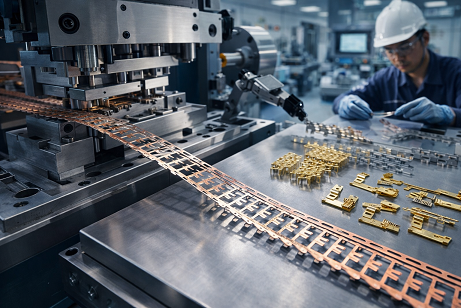
Connector Stamping Vietnam has emerged as a strategic manufacturing solution for global OEMs requiring high-speed, high-precision terminal components. As electronic systems become more compact and performance-driven, connector reliability directly affects signal stability, power distribution, and overall product durability. Therefore, precision stamping processes must deliver tight tolerances, consistent conductivity, and scalable production capacity.
Vietnam’s industrial ecosystem now supports advanced Connector Stamping Vietnam capabilities through progressive dies, high-speed presses, and automated inspection systems. With competitive cost structures and strong export infrastructure, the country provides a compelling transactional option for electronics manufacturers seeking reliable supply partners.
Connector Stamping Vietnam for High-Volume Production
Connector Stamping Vietnam focuses on producing intricate metal terminals used in automotive electronics, consumer devices, telecommunications equipment, and industrial control systems. Because connectors operate in high-vibration and high-temperature environments, dimensional accuracy and material integrity are critical.
Vietnamese manufacturers operate high-speed stamping lines capable of thousands of strokes per minute. These systems maintain tight repeatability while reducing material waste. As a result, large production volumes can be achieved without compromising precision.
Tooling design plays a central role in process stability. Progressive dies are engineered to perform multiple forming operations in a single cycle. This integrated approach improves efficiency while preserving structural consistency across complex terminal geometries.
Moreover, reel-to-reel processing enhances productivity for continuous terminal strip production. Automated feeding systems reduce handling errors and improve cycle time predictability.
Precision Engineering and Material Selection
Material performance determines connector reliability. Copper alloys such as phosphor bronze and brass are widely used due to their electrical conductivity and formability.
In addition, beryllium copper may be selected for applications requiring superior spring properties. Manufacturers evaluate mechanical strength, fatigue resistance, and plating compatibility before finalizing material specifications.
Advanced simulation software assists engineers in predicting spring-back behavior and stress distribution. By optimizing tooling geometry in the early design phase, suppliers reduce production adjustments and accelerate time-to-market.
Secondary operations such as deburring, forming refinement, and inspection further enhance part performance. Consequently, finished terminals meet strict dimensional and electrical requirements.
Gold-plated terminals for Enhanced Conductivity
Gold-plated terminals provide superior corrosion resistance and long-term electrical stability. In high-frequency or low-voltage applications, gold plating ensures minimal signal loss and contact resistance.
Vietnamese suppliers integrate electroplating lines within their stamping operations. Controlled plating thickness guarantees consistent performance across production batches. Moreover, strict surface preparation processes improve adhesion and reduce defects.
Because plating quality directly impacts connector lifespan, manufacturers conduct adhesion tests, thickness measurements, and surface inspections before shipment. This structured quality control ensures that performance expectations align with OEM standards.
Lead frame stamping in Semiconductor Applications
Lead frame stamping supports semiconductor packaging and microelectronic assemblies. These thin, high-precision frames connect integrated circuits to external circuitry.
Vietnam’s Connector Stamping Vietnam suppliers increasingly invest in fine blanking and micro-stamping technology to serve semiconductor clients. Tight tolerances and smooth edge finishes are essential to prevent electrical failure.
Additionally, material flatness and dimensional stability influence bonding performance during chip assembly. Engineers carefully monitor press force and die alignment to maintain consistent results.
Through advanced tooling and quality validation, manufacturers achieve reliable lead frame production suitable for high-volume semiconductor manufacturing.
Case Study: High-Speed Automotive Connector Production
A European automotive electronics supplier sought a cost-effective alternative manufacturing base for high-volume terminal production. The client required strict tolerance control, gold plating consistency, and rapid scaling capacity.
Vietnamese manufacturers proposed a progressive die solution operating at over 800 strokes per minute. By integrating stamping, plating, and inspection in a single facility, production lead time was reduced by 18 percent.
Furthermore, automated optical inspection minimized defect rates and improved process transparency. Within six months, the supplier achieved stable production at full capacity while maintaining compliance with automotive quality standards.
This case demonstrates how Connector Stamping Vietnam supports global OEMs at the bottom-of-funnel procurement stage.
Quality Control and Process Validation
Reliable connector production requires disciplined quality management. Vietnamese suppliers implement ISO 9001-certified systems with structured documentation and traceability.
Incoming material inspection verifies alloy composition and thickness. During stamping, press monitoring systems track force and alignment in real time. After forming and plating, optical measurement systems validate dimensions and surface finish.
Statistical process control methods detect deviations before they affect final output. If anomalies occur, corrective action protocols are immediately initiated.
Before shipment, final inspection confirms packaging integrity to prevent transit damage. This comprehensive approach ensures consistent performance across international supply chains.
Integration with Broader Electronics Manufacturing
Connector components function within a wider manufacturing network.
For a comprehensive overview of related precision capabilities, explore Electronics Metal Forming solutions that support shielding, micro-stamped parts, and structural components in advanced electronic assemblies.
By consolidating multiple component categories under a single regional supply base, OEMs streamline procurement and improve quality consistency.
Compliance and Export Readiness
Vietnamese connector manufacturers align with RoHS and REACH regulations for material safety compliance. Environmental management systems further support sustainable production practices.
In addition, suppliers provide full documentation packages, including material certificates, plating reports, and inspection records. This transparency simplifies international audits and strengthens buyer confidence.
Strategic trade agreements enhance export competitiveness to North America and Europe. Reduced tariffs and efficient port infrastructure contribute to optimized landed cost.
Cost Efficiency and Scalability
Connector Stamping Vietnam offers a balanced cost-performance proposition. Labor and operational expenses remain competitive compared to mature markets, while technical capabilities continue to improve.
Scalable production capacity allows suppliers to support both pilot runs and high-volume programs. As demand increases, manufacturers expand press capacity without compromising precision.
Stable political conditions and growing industrial infrastructure further enhance supply chain reliability. For companies diversifying manufacturing bases, Vietnam presents a strategic alternative with long-term potential.
Engineering Collaboration and DFM Support
Early-stage engineering collaboration reduces risk and accelerates project timelines. Vietnamese manufacturers provide design for manufacturability consultation to optimize geometry and material usage.
Simulation tools validate die performance and forming behavior before tooling fabrication. Consequently, buyers experience fewer revisions and shorter development cycles.
Prototype validation ensures that mechanical and electrical performance aligns with final specifications. This proactive process builds trust and supports long-term partnerships.
Conclusion
Connector Stamping Vietnam delivers high-speed precision manufacturing for terminals, gold-plated connectors, and lead frame components used across global electronics industries. With advanced tooling, integrated plating, strict quality control, and competitive cost structures, Vietnam has positioned itself as a reliable sourcing destination.
As electronic systems demand greater performance and miniaturization, precision connector manufacturing becomes increasingly critical. Businesses seeking scalable, compliant, and performance-driven solutions should consider Vietnam as a strategic partner for connector stamping projects.
Contact a qualified Vietnamese manufacturer today to discuss technical requirements, material options, and production timelines for your next connector program.