
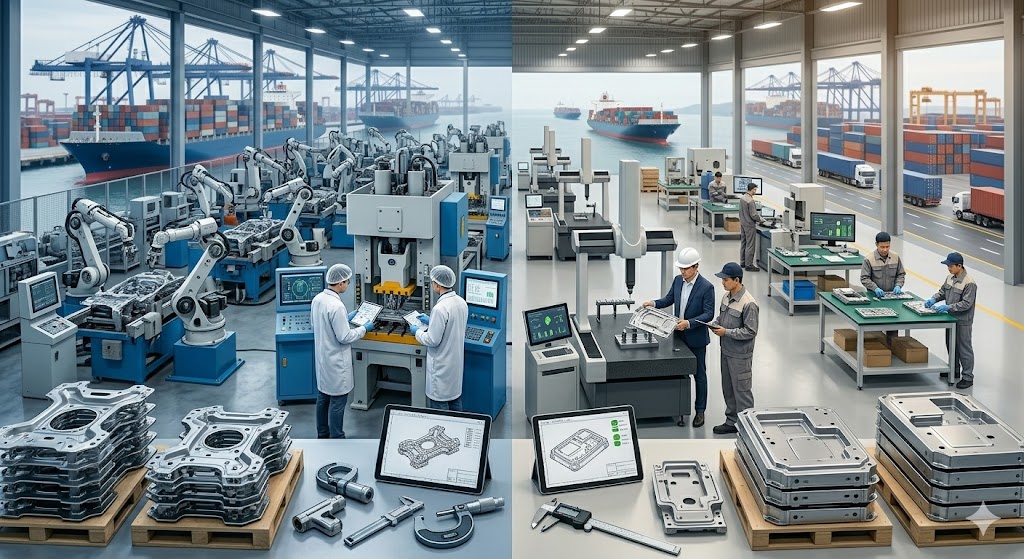
Vietnam vs China has become one of the most critical strategic evaluations for global manufacturers in 2026. As trade dynamics evolve and supply chains restructure, procurement leaders must compare cost structures, tariff exposure, compliance requirements, and production scalability before committing to long-term sourcing decisions.
In the context of global manufacturing diversification, Vietnam vs China is no longer a simple cost comparison. Instead, it reflects broader considerations including trade war 2026 developments, regulatory compliance in Europe, US tariff policy, and logistics performance to North America.
This guide provides a structured analysis to support data-driven sourcing decisions for metal forming programs.
Vietnam vs China: Cost Structure Comparison
Cost remains a primary factor in the Vietnam vs China decision framework. China continues to benefit from deep industrial ecosystems, vertically integrated supply chains, and massive production scale. However, Vietnam has steadily narrowed the capability gap while offering cost advantages in certain segments.
Key cost comparison elements include:
Labor cost per hour
Tooling investment
Industrial overhead
Utility pricing
Land lease rates
Vietnam generally offers competitive labor costs compared to coastal China. Furthermore, industrial park incentives and tax advantages strengthen its pricing position.
However, China’s advanced automation and mature supply networks can offset higher wage levels through productivity efficiency. Therefore, buyers must evaluate cost per unit rather than labor rate alone.
Trade War 2026 and Tariff Exposure
The evolving Trade war 2026 landscape continues to shape sourcing strategies. US-China tariff tensions have influenced procurement decisions for several years. As a result, companies increasingly evaluate Vietnam as an alternative production base to mitigate tariff risk.
US tariffs on certain Chinese metal parts have raised landed cost for North American buyers. In contrast, Vietnam benefits from different trade classifications and bilateral agreements.
For a detailed breakdown of US policy impact, see our guide on US Tariffs 2026 and Vietnam’s competitive position.
Diversifying production beyond China reduces exposure to unpredictable tariff escalation.
Manufacturing Shift and Supply Chain Diversification
A significant Manufacturing shift is underway across Asia. Multinational corporations are expanding or relocating part of their production footprint to Southeast Asia.
Vietnam’s advantages in this transition include:
Political stability
Expanding export infrastructure
Skilled workforce growth
Trade agreement participation
Rising engineering capability
However, China retains unmatched scale for ultra-high-volume manufacturing and highly complex integrated production.
Rather than replacing China entirely, many firms implement dual-country strategies to balance resilience and efficiency.
Infrastructure and Industrial Ecosystem
China’s industrial infrastructure remains the most comprehensive globally. From raw material processing to advanced machining, integrated supply chains support rapid scaling.
Vietnam’s ecosystem, although smaller, is expanding rapidly. Foreign direct investment continues to enhance technological capacity and production quality.
Moreover, Vietnam’s government actively supports export-oriented manufacturing. Industrial parks near major ports reduce logistics friction and improve shipment predictability.
In mid-complexity metal forming applications, Vietnam increasingly matches China’s performance levels.
Regulatory and Environmental Compliance
Compliance requirements are tightening globally, especially in Europe. Carbon-related regulations now influence supplier selection.
For European markets, review our analysis of CBAM Compliance Vietnam and how Vietnamese manufacturers address green metal forming standards.
China has advanced environmental regulations, but compliance cost can increase operational expense. Vietnam, meanwhile, continues investing in energy-efficient production and sustainable sourcing practices.
As ESG considerations rise, compliance transparency becomes a competitive differentiator.
Logistics and Lead Time Performance
Logistics reliability remains a decisive factor in the Vietnam vs China comparison.
China benefits from vast port infrastructure and extensive global shipping networks. However, geopolitical tensions and port congestion can introduce unpredictability.
Vietnam’s logistics capacity has improved significantly. Ports such as Hai Phong and Ho Chi Minh City support growing export volumes.
For detailed performance metrics, see our analysis of Vietnam Lead Times to North America.
While transit times from Vietnam may be slightly longer in some cases, diversification reduces concentration risk and improves supply resilience.
Quality Control and Technical Capability
China’s long-standing manufacturing expertise supports advanced tooling and automation systems. Many Tier 1 suppliers operate world-class facilities.
Vietnam, on the other hand, has rapidly improved quality management systems. ISO certifications, foreign-invested factories, and export-driven quality standards have elevated reliability.
In precision stamping and mid-complexity forming, Vietnamese suppliers demonstrate stable performance. However, extremely high-tolerance applications may still favor China’s deeper industrial specialization.
Buyers should conduct supplier audits in both countries before finalizing sourcing decisions.
Labor Market and Workforce Development
China faces rising labor costs in major industrial regions. Additionally, demographic trends influence workforce availability.
Vietnam’s younger labor force supports expanding manufacturing capacity. Technical training programs and foreign investment continue to strengthen skill levels.
Although productivity in China remains higher in some advanced segments, Vietnam’s productivity gap is narrowing steadily.
Long-term workforce availability therefore favors diversified strategies.
Currency and Financial Stability
Currency exposure influences total landed cost. China’s currency management policies and trade tensions can impact exchange rate stability.
Vietnam’s currency remains relatively stable, yet import-dependent raw material sourcing can introduce cost variability.
Financial planning and hedging strategies remain essential in both markets.
Strategic Context Within Sourcing Strategy 2026
Vietnam vs China analysis should align with broader corporate sourcing objectives.
For a comprehensive overview, refer to our strategic guide on Sourcing Strategy 2026 and how cost, tariffs, and compliance integrate into long-term planning.
Successful companies adopt multi-country production models to balance efficiency and resilience.
Risk Mitigation and Long-Term Outlook
Geopolitical risk continues to influence manufacturing geography. Companies overly concentrated in one country face higher exposure to regulatory or tariff shocks.
A dual-sourcing model combining Vietnam and China often provides the optimal balance. China supports high complexity and ecosystem depth. Vietnam supports cost diversification and tariff flexibility.
Looking ahead to 2026 and beyond, both countries will remain central to global metal forming supply chains. However, the relative weighting within sourcing portfolios may continue shifting toward Vietnam.
Conclusion: Choosing Between Vietnam vs China
Vietnam vs China is not a binary decision. Instead, it represents a strategic allocation choice within a diversified sourcing portfolio.
China offers unmatched scale and advanced integration. Vietnam offers competitive cost, tariff advantages, and growing industrial maturity.
Procurement leaders must evaluate cost structure, tariff exposure, compliance readiness, logistics performance, and long-term resilience before committing to production transfers.
If your organization is evaluating metal forming production in Asia for 2026, our team can provide cost modeling, tariff analysis, and supplier benchmarking tailored to your requirements.
Contact us today to develop a balanced sourcing strategy that leverages the strengths of both Vietnam and China while minimizing operational risk.