ESG Metal Forming is transforming Vietnam’s industrial sector as sustainability becomes a core requirement for global supply chains. In 2026, environmental compliance, carbon transparency, and responsible governance are no longer optional criteria. Instead, they directly influence procurement decisions across automotive, construction, renewable energy, and heavy machinery industries.
As international buyers raise ESG expectations, Vietnam’s metal forming ecosystem has accelerated its transition toward cleaner energy, smarter operations, and resource-efficient production models. Consequently, sustainable manufacturing now supports both regulatory readiness and long-term competitiveness.
The Strategic Importance of ESG Metal Forming in 2026
Global regulations continue to tighten. At the same time, investors demand ESG disclosures, and multinational corporations impose sustainability standards on suppliers. Under these conditions, ESG Metal Forming becomes a structural advantage rather than a compliance burden.
By optimizing energy usage, reducing scrap, and implementing emissions tracking systems, manufacturers can deliver measurable environmental performance. Furthermore, transparent reporting reduces compliance risk for overseas buyers. Therefore, sustainability directly supports stable, long-term B2B partnerships.
Vietnam’s Transition Toward Sustainable Industrial Practices
Over the past decade, Vietnam has modernized its industrial infrastructure. Many export-focused factories now operate under ISO-certified environmental management systems. In addition, digital monitoring tools allow facilities to track electricity consumption and production efficiency in real time.
Rather than relying solely on conventional power sources, manufacturers increasingly integrate renewable energy solutions. As a result, carbon intensity per unit of output continues to decline. These structural improvements position Vietnam as a competitive alternative within Asia’s manufacturing landscape.
Eco-friendly factory Standards in Modern Operations
Eco-friendly factory
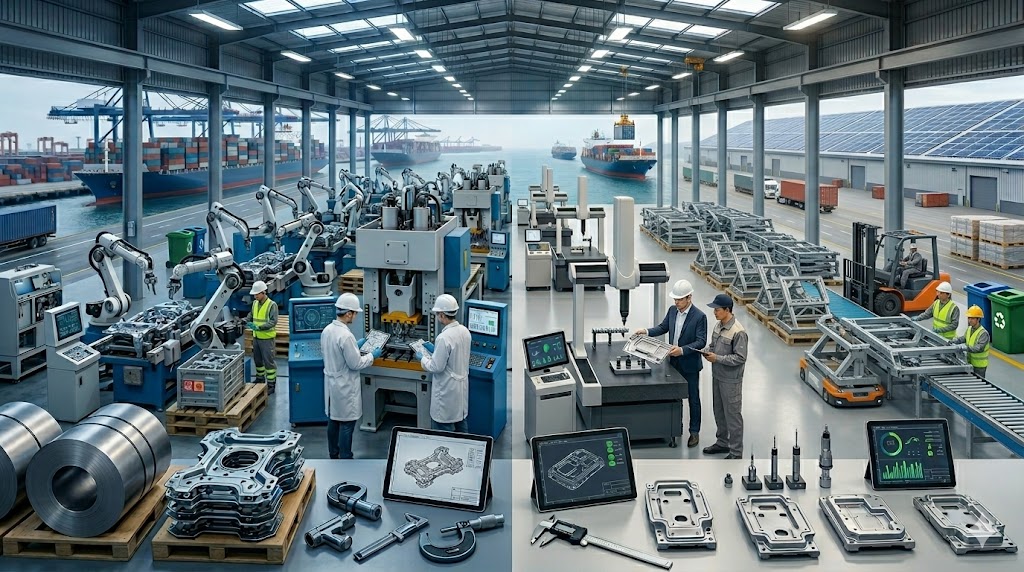
An eco-friendly factory integrates environmental responsibility into daily production processes. In Vietnam, leading metal forming plants deploy energy-efficient presses, LED lighting retrofits, and advanced dust filtration systems.
Moreover, wastewater treatment systems ensure regulatory compliance while protecting surrounding communities. Through systematic upgrades, factories improve environmental metrics without compromising productivity.
Such eco-friendly factory initiatives contribute to broader sustainability objectives and strengthen supplier credibility in global markets.
Circular manufacturing and Resource Efficiency
Circular manufacturing
Circular manufacturing reduces waste by keeping materials in continuous use. Within metal forming operations, this approach minimizes scrap generation and enhances recycling loops.
Instead of discarding excess material, facilities separate and reprocess scrap through certified channels. Consequently, raw material demand decreases, and overall carbon footprint improves.
By implementing circular manufacturing principles, companies align economic efficiency with environmental responsibility. This dual benefit enhances profitability while supporting sustainable supply chain commitments.
Renewable Energy Integration and Solar Innovation
Solar Powered Factory
Industrial rooftops across Vietnam increasingly host photovoltaic systems. A Solar Powered Factory model lowers reliance on fossil-fuel-based electricity while stabilizing long-term energy costs.
In addition, renewable integration supports international carbon reduction targets. Buyers seeking low-emission sourcing partners therefore view Solar Powered Factory operations as strategic advantages.
Energy diversification not only reduces scope 2 emissions but also strengthens supply chain resilience in the face of fluctuating grid conditions.
Metal Recycling Vietnam and Closed-Loop Systems
Metal Recycling Vietnam programs reinforce responsible material management across industrial zones. Structured recycling partnerships ensure scrap material re-enters certified processing facilities instead of landfills.
Recycled steel and aluminum significantly reduce embodied carbon compared to virgin raw materials. Furthermore, documented recycling flows enhance traceability and reporting accuracy.
Through Metal Recycling Vietnam initiatives, sustainable production becomes measurable, verifiable, and commercially viable.
Smart Factory Vietnam and Digital Optimization
Digital transformation plays a central role in modern sustainability strategies. Smart Factory Vietnam solutions integrate data analytics, automation, and digital twin simulations into forming operations.
Before launching full production, manufacturers simulate processes virtually to reduce trial errors and material waste. Predictive maintenance systems also prevent energy inefficiencies caused by unexpected downtime.
As digital visibility improves, environmental performance becomes easier to manage and optimize. Smart Factory Vietnam implementation therefore supports long-term operational excellence.
Alignment with Sourcing Strategy 2026
Sustainability must connect with procurement strategy to generate real impact.
Sourcing Strategy 2026
Sourcing Strategy 2026 frameworks increasingly incorporate ESG metrics alongside cost, quality, and logistics. Companies evaluating Vietnam suppliers now assess carbon transparency, renewable energy adoption, and waste management practices.
By embedding sustainability into Sourcing Strategy 2026 planning, buyers mitigate regulatory exposure while strengthening corporate reputation. Vietnam’s progress in responsible manufacturing supports diversified and future-ready supply chains.
Financial and Competitive Benefits
While sustainability investments require capital, long-term returns justify the transition. Energy-efficient systems reduce operational expenses. Waste minimization improves material yield. Renewable adoption stabilizes cost structures over time.
Additionally, ESG-aligned manufacturers gain access to preferred vendor programs and ESG-linked financing mechanisms. These advantages improve contract stability and investor confidence.
Consequently, sustainable production enhances both environmental performance and financial resilience.
Risk Mitigation and Regulatory Readiness
Global carbon policies continue to evolve. Therefore, suppliers must anticipate regulatory shifts rather than react to them. Transparent data systems, structured emissions tracking, and renewable integration reduce exposure to compliance penalties.
Buyers benefit from stable sourcing relationships supported by verifiable environmental performance. As sustainability expectations intensify, early adopters secure stronger market positioning.
The Future of Sustainable Metal Forming in Vietnam
Vietnam’s industrial sector is entering a new phase defined by innovation and responsibility. Through renewable energy integration, digital transformation, and resource optimization, sustainable manufacturing continues to mature.
Rather than viewing ESG as an external requirement, forward-looking manufacturers embed sustainability into core strategy. This integrated approach strengthens competitiveness across global markets.
If your organization seeks resilient and environmentally responsible sourcing partners, Vietnam’s sustainable metal forming ecosystem offers measurable progress and strategic alignment for 2026 and beyond. Contact our team to explore tailored manufacturing solutions that support both commercial growth and sustainability objectives.