
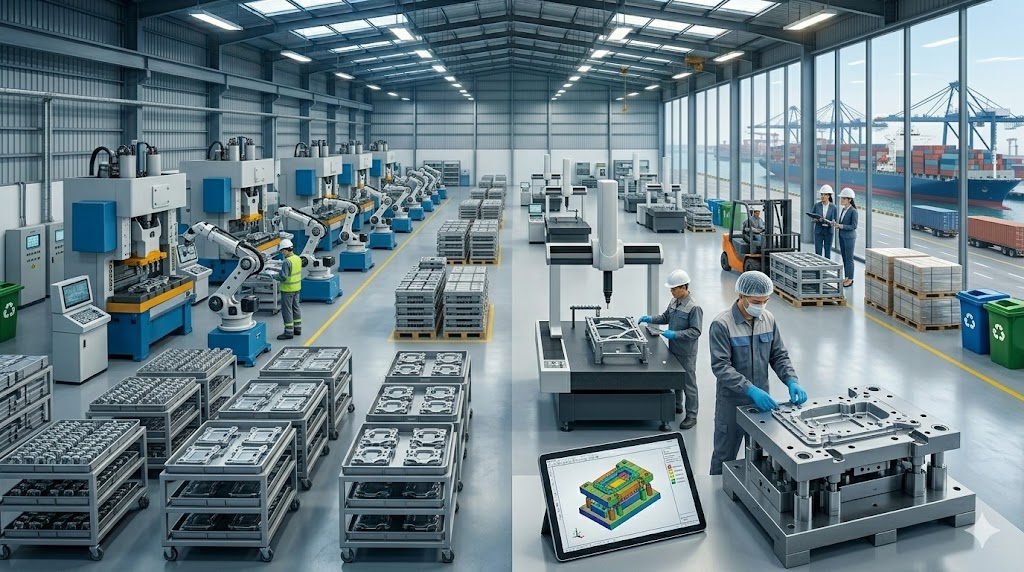
Smart Factory Vietnam is rapidly redefining industrial competitiveness through digital twin forming technologies, AI-driven quality control, and predictive maintenance systems. As global buyers demand higher precision, shorter lead times, and stronger ESG compliance, Vietnamese manufacturers are deploying intelligent factory architectures to increase operational transparency and measurable ROI. In 2026, Smart Factory Vietnam is no longer a conceptual roadmap. It is a commercially viable production model delivering quantifiable performance improvements.
Digital twin forming sits at the center of this transformation. By creating a virtual replica of physical production systems, manufacturers simulate forming processes, monitor real-time performance, and optimize machine parameters before defects occur. Consequently, production efficiency improves while scrap and downtime decrease.
The Strategic Role of Smart Factory Vietnam in Metal Forming
Vietnam’s metal forming sector has expanded significantly in automotive, industrial equipment, aerospace components, and construction machinery. However, cost competitiveness alone is insufficient in today’s procurement landscape. Buyers now evaluate suppliers based on digital capability, traceability, and production resilience.
Smart Factory Vietnam integrates data connectivity across machines, sensors, and enterprise systems. Through industrial IoT networks, presses, CNC machines, robotic arms, and inspection units communicate continuously. This connectivity enables centralized monitoring dashboards and predictive analytics models.
Moreover, digital twin forming allows engineers to simulate die performance, material flow, and forming stress before physical tooling adjustments. As a result, manufacturers reduce trial-and-error iterations, shorten development cycles, and increase first-pass yield rates.
These improvements directly affect ROI. Reduced scrap, minimized downtime, and faster ramp-up times strengthen cost efficiency and customer satisfaction simultaneously.
Digital Twin Forming: Core Architecture
Digital twin forming combines simulation software, sensor data acquisition, and cloud-based analytics. The physical production line continuously feeds operational data into a digital model. This model reflects machine status, temperature, vibration levels, forming pressure, and dimensional accuracy.
When deviations occur, the system generates alerts. Engineers can analyze root causes virtually before interrupting the physical process. Consequently, production remains stable while corrective action becomes more precise.
In stamping operations, digital twins simulate material springback and die wear progression. In die casting, they model thermal behavior and cycle time optimization. In machining, they track tool wear patterns and vibration anomalies.
Because Smart Factory Vietnam integrates these capabilities, manufacturers gain predictive visibility rather than reactive problem solving.
AI Inspection in Smart Factory Vietnam
Quality control has traditionally relied on manual inspection or post-production sampling. However, Smart Factory Vietnam incorporates AI inspection systems that analyze parts in real time.
High-resolution cameras capture component surfaces. Machine learning algorithms detect micro-defects, dimensional deviations, and surface irregularities. Unlike human inspection, AI systems operate continuously without fatigue.
Additionally, AI inspection data feeds back into digital twin models. When recurring defects appear, the system correlates anomalies with machine parameters. Therefore, forming pressure, temperature settings, or tooling alignment can be adjusted proactively.
This closed feedback loop reduces rejection rates and improves customer confidence. International buyers benefit from consistent quality documentation and digital traceability records.
Predictive Maintenance and Downtime Reduction
Unplanned downtime remains one of the largest cost drivers in metal forming plants. Unexpected press failure or spindle breakdown can disrupt entire production schedules.
Smart Factory Vietnam addresses this challenge through predictive maintenance. Sensors monitor vibration patterns, motor currents, hydraulic pressure fluctuations, and temperature variations. Advanced analytics identify abnormal trends before critical failure occurs.
Instead of following fixed maintenance intervals, factories schedule interventions based on actual machine condition. This strategy extends equipment lifespan while minimizing unnecessary stoppages.
Predictive maintenance also enhances safety performance. Early detection of mechanical stress prevents catastrophic breakdowns and reduces workplace risk.
In commercial terms, fewer production interruptions translate directly into stronger delivery reliability and improved ROI metrics.
ROI Analysis: Commercial Impact for 2026
Smart Factory Vietnam investments require capital expenditure in software platforms, sensors, AI systems, and training. Therefore, ROI assessment remains central to adoption decisions.
However, measurable benefits typically include:
Reduced scrap rates due to digital twin optimization
Lower rework costs through AI inspection
Decreased downtime via predictive maintenance
Faster tooling development cycles
Improved energy efficiency from real-time monitoring
Over a three to five-year horizon, many factories achieve substantial operational savings. Additionally, digital capability enhances eligibility for high-value international contracts.
Because 2026 procurement environments prioritize sustainability and traceability, Smart Factory Vietnam becomes both a productivity and market-access strategy.
Data Transparency and Global Buyer Expectations
Global OEMs increasingly require digital production records. They expect documentation covering inspection results, maintenance logs, and process parameters.
Smart Factory Vietnam enables centralized data storage and traceability. Each component batch can be linked to production conditions and quality inspection outcomes. This transparency reduces dispute risk and strengthens long-term partnerships.
Furthermore, digital twin models provide simulation data during product development discussions. Buyers gain confidence in supplier engineering capability before tooling investment begins.
As a result, smart factory adoption supports stronger commercial positioning rather than merely internal efficiency gains.
Workforce Transformation in Smart Factory Vietnam
Technology implementation also changes workforce requirements. Operators transition from manual monitoring to data-driven supervision roles. Engineers require skills in simulation modeling, analytics interpretation, and digital system integration.
Training programs therefore become essential. Many Vietnamese manufacturers collaborate with technology providers and universities to build digital competencies.
When employees understand predictive dashboards and AI feedback systems, operational decisions become more accurate. This human-machine collaboration strengthens overall factory performance.
Integration Within Sustainable Manufacturing Strategy
Digital transformation aligns closely with environmental objectives.
For a broader strategic framework, review Sustainable Manufacturing: ESG Metal Forming 2026. This pillar explains how environmental governance, renewable energy adoption, and digital optimization converge to strengthen Vietnam’s industrial ecosystem.
Within that context, Smart Factory Vietnam supports measurable carbon reduction through improved process efficiency and minimized waste generation.
AI Inspection and Quality Intelligence
Advanced inspection systems enhance both productivity and compliance.
Learn more about AI inspection technologies that enable real-time defect detection and automated quality control in metal forming operations. These systems reduce reliance on manual checks while increasing traceability for international audits.
By integrating AI inspection into smart factory infrastructure, manufacturers achieve consistent output quality and faster corrective action cycles.
Predictive Maintenance and Operational Resilience
Equipment reliability directly affects commercial performance.
Explore Predictive maintenance strategies that utilize sensor analytics and machine learning to anticipate failures before disruption occurs. This approach ensures stable production schedules and optimized maintenance budgeting.
Through predictive maintenance, Smart Factory Vietnam improves delivery reliability while extending asset lifespan.
Competitive Outlook for 2026
As industrial buyers intensify digital and ESG evaluation criteria, Smart Factory Vietnam positions manufacturers ahead of regulatory and market shifts. Digital twin forming, AI inspection, and predictive maintenance together create a fully integrated intelligent production environment.
Factories that adopt these systems gain operational transparency, cost predictability, and stronger commercial leverage. Instead of competing solely on price, they compete on performance, traceability, and long-term reliability.
Conclusion
Smart Factory Vietnam represents a transformative evolution in metal forming operations. By integrating digital twin forming, AI inspection, and predictive maintenance, Vietnamese manufacturers enhance efficiency, reduce risk, and strengthen ROI in 2026 and beyond.
For B2B buyers seeking technologically advanced and ESG-aligned partners, suppliers operating under Smart Factory Vietnam frameworks offer measurable advantages. As digital maturity becomes a defining competitive factor, intelligent factories will shape the future of global manufacturing partnerships.