
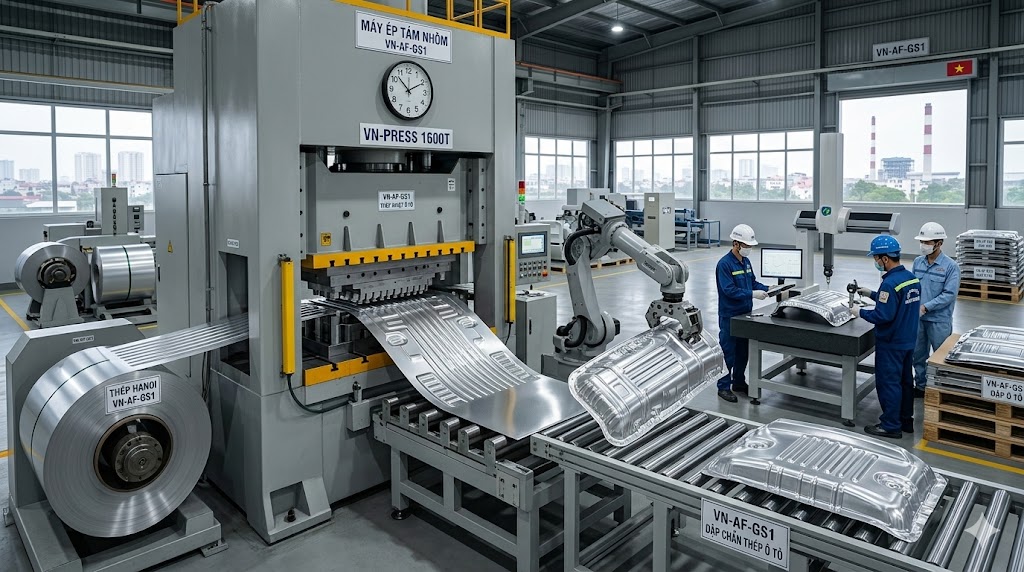
Heat Shield Forming plays a critical role in protecting modern vehicles from extreme thermal exposure. As engine systems, turbochargers, and electric drivetrains generate higher temperatures, manufacturers require precisely formed aluminum components to manage heat efficiently. In Vietnam, specialized forming facilities now deliver high-volume heat shield production aligned with Tier 1 automotive sourcing standards.
Heat Shield Forming involves shaping thin-gauge aluminum sheets into geometries that deflect, dissipate, or insulate heat. Because these components operate in high-temperature environments, forming precision and material integrity are essential. Therefore, Vietnamese manufacturers combine advanced tooling design, progressive stamping lines, and controlled forming processes to maintain consistent quality.
As global OEMs diversify sourcing networks, Vietnam has become a competitive hub for automotive thermal protection components.
Why Heat Shield Forming Is Essential for Automotive Systems
Modern vehicles operate under increasing thermal stress. Exhaust systems, battery modules, and power electronics generate heat that must be carefully managed to prevent damage.
Heat Shield Forming produces lightweight protective barriers that reduce heat transfer to sensitive components. Aluminum’s high reflectivity and low density make it ideal for this purpose. Consequently, formed shields enhance vehicle safety and durability without adding unnecessary mass.
In addition, precise geometry ensures optimal airflow and structural stability. Poorly formed shields may rattle or deform, reducing effectiveness. Therefore, manufacturing control is vital.
Thermal Management Through Engineered Aluminum Design
Effective thermal control depends on material selection and geometry optimization.
Thermal management
Thermal management in automotive heat shield applications involves controlling radiant and conductive heat exposure through precisely formed aluminum barriers. Properly engineered shields reflect heat away from fuel lines, wiring systems, and battery modules.
By maintaining dimensional accuracy during Heat Shield Forming, manufacturers ensure predictable thermal performance under extreme operating conditions.
Reflective Surface Performance
Aluminum naturally reflects radiant heat. Forming processes must preserve surface integrity to maintain this property.
Structural Reinforcement for Vibration Resistance
Automotive environments expose shields to constant vibration. Engineers incorporate rib patterns and contour shaping to enhance rigidity without increasing thickness.
Embossed Aluminum for Strength and Noise Reduction
Thin-gauge aluminum requires structural reinforcement to prevent deformation.
Embossed aluminum
Embossed aluminum patterns created during Heat Shield Forming increase stiffness while maintaining lightweight characteristics. These embossed geometries improve vibration damping and reduce noise transmission.
Through controlled stamping and forming sequences, manufacturers produce consistent embossing depth across production runs.
Controlled Forming Parameters
Precision die tooling regulates emboss depth and spacing. Consequently, uniformity improves across high-volume automotive programs.
Lightweight Optimization
Embossed designs allow thinner base material while preserving structural integrity. This balance supports vehicle weight reduction targets.
Technical Workflow of Heat Shield Forming
Vietnamese facilities apply a structured manufacturing process to ensure quality and repeatability.
Material Preparation
Aluminum coils undergo inspection for thickness uniformity and surface condition. Proper preparation reduces downstream defects.
Progressive Stamping and Forming
Forming operations shape shields into complex contours. Multi-stage tooling ensures gradual deformation without tearing.
Edge Trimming and Finishing
After forming, edges are trimmed to precise specifications. Clean edges prevent installation issues and ensure assembly compatibility.
Inspection and Quality Verification
Inline measurement systems verify geometry and emboss consistency. Final inspection confirms tolerance compliance before packaging.
Integration Within Automotive Metal Forming Infrastructure
Heat shield production operates within a broader automotive manufacturing framework.
Automotive Metal Forming in Vietnam provides the stamping infrastructure, tooling expertise, and quality systems that support Heat Shield Forming operations. This integrated ecosystem ensures consistent process validation and Tier 1 sourcing alignment.
By leveraging Automotive Metal Forming capabilities, suppliers maintain synchronized production planning and traceability across automotive programs.
Applications Across Combustion and Electric Vehicles
Heat shields remain essential in both traditional and electric platforms.
In combustion vehicles, shields protect fuel systems and cabin floors from exhaust heat. Meanwhile, electric vehicles require thermal barriers around battery packs and power electronics.
Heat Shield Forming adapts to these varied applications through flexible tooling and material optimization. Consequently, suppliers can support multiple vehicle architectures within the same production environment.
Quality Assurance and Compliance
Automotive components demand consistent quality documentation. Manufacturers implement layered inspection protocols that include:
- Incoming material verification
- Tool wear monitoring
- Inline geometry inspection
- Surface finish assessment
- Final batch traceability
These systems reduce risk and support global sourcing requirements.
Furthermore, digital production tracking enhances process transparency. Buyers benefit from documented compliance and consistent output.
Commercial Advantages for BOFU Buyers
Transactional buyers evaluate suppliers based on technical competence and cost stability. Vietnam offers competitive production economics while maintaining export-ready quality standards.
Modern press lines and automation investments enable high-volume output. Additionally, engineering collaboration during early design stages accelerates tooling development and shortens project timelines.
Heat Shield Forming in Vietnam provides flexibility for mid- to high-volume automotive programs. Therefore, procurement teams can secure reliable supply without excessive capital investment.
Future Outlook for Automotive Heat Shield Production
Vehicle electrification and stricter emissions regulations continue to influence thermal design. As a result, heat shield geometry becomes more sophisticated.
Vietnamese manufacturers increasingly adopt simulation software and automated monitoring to enhance forming precision. Sustainability initiatives also encourage material efficiency and scrap reduction.
With growing demand for lightweight thermal protection components, Heat Shield Forming remains a critical capability within the automotive supply chain.
Conclusion
Heat Shield Forming in Vietnam delivers precision embossed aluminum components that support automotive thermal management and structural integrity. Through controlled forming processes, advanced tooling, and integrated Automotive Metal Forming infrastructure, manufacturers provide scalable and compliant production solutions.
For BOFU buyers seeking reliable aluminum specialists, Vietnam offers a technically capable and commercially competitive partner in automotive heat shield manufacturing.