
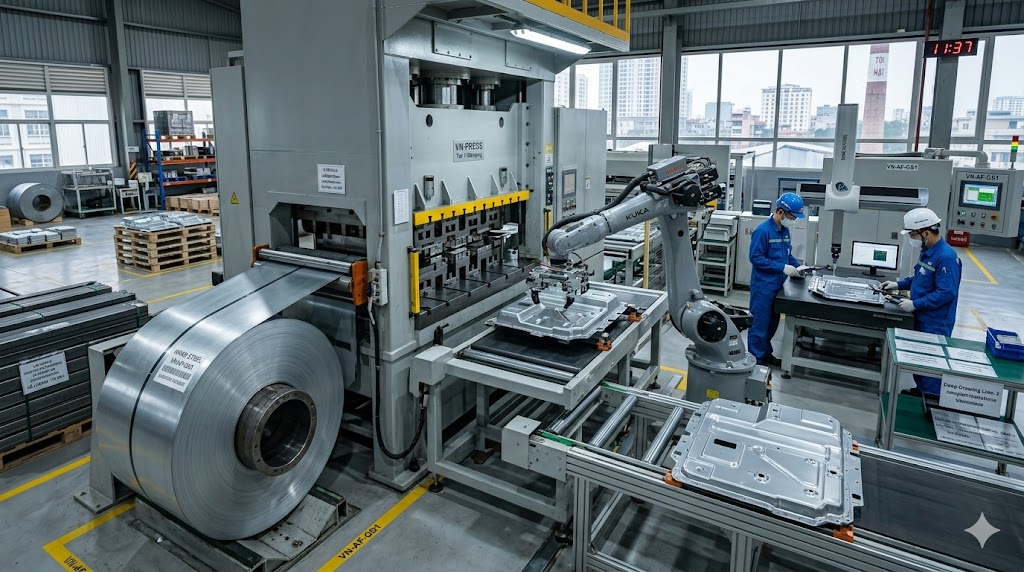
Automotive Metal Forming in Vietnam has evolved into a strategic sourcing solution for global Tier 1 and Tier 2 suppliers. As vehicle platforms become more complex and electrification accelerates, manufacturers require precision components that meet strict safety, performance, and compliance standards. Vietnam’s expanding industrial base now supports high-volume automotive programs with certified quality systems and scalable production capacity.
In recent years, Automotive Metal Forming has shifted beyond basic stamping operations. Today, it integrates advanced tooling design, automation, material optimization, and digital inspection systems. Consequently, buyers gain access to IATF-certified production environments capable of delivering mission-critical components for combustion and electric vehicle platforms.
Why Automotive Metal Forming Vietnam Supports Tier 1 Sourcing
Tier 1 suppliers prioritize reliability, traceability, and repeatable quality. Automotive programs demand strict tolerance control and validated production processes.
Automotive Metal Forming in Vietnam aligns with these expectations by combining technical capability with cost competitiveness. Factories invest in progressive dies, transfer presses, robotic handling, and inline measurement systems. Therefore, dimensional consistency is maintained across large production runs.
Additionally, Vietnam benefits from favorable trade agreements and expanding infrastructure. As a result, logistics timelines remain competitive for North American, European, and Asian OEM networks.
IATF-Compliant Production Systems
IATF 16949 parts
IATF 16949 parts produced in Vietnam follow standardized quality management systems tailored for automotive manufacturing. Process validation, failure mode analysis, and continuous improvement protocols ensure product reliability.
By implementing documented traceability and statistical process control, manufacturers reduce risk and enhance supply chain transparency.
EV Battery Housings and Electrification Components
The rapid growth of electric vehicles has increased demand for lightweight yet structurally robust enclosures.
EV battery housings
EV battery housings manufactured through Automotive Metal Forming must balance structural integrity, thermal management, and weight efficiency. Precision stamping and forming processes allow controlled shaping of aluminum and high-strength steel panels used in battery packs.
Moreover, forming accuracy directly affects sealing performance and assembly precision in electric vehicle systems.
Structural Strength and Safety Requirements
Battery enclosures must withstand vibration, impact, and thermal expansion. Therefore, material selection and forming geometry require engineering collaboration between supplier and OEM.
Lightweight Optimization
Advanced forming techniques enable reduced material thickness without compromising strength. This approach supports overall vehicle weight reduction targets.
Comprehensive Automotive Component Capabilities
Vietnamese automotive forming suppliers provide a wide range of components across vehicle systems.
These include:
- Structural brackets
- Cross members
- Reinforcement plates
- Mounting rails
- Engine and chassis supports
- Thermal shielding components
Through automation and tooling precision, manufacturers maintain consistency across high-volume contracts.
Integration Within Industrial Metal Forming Ecosystem
Automotive metal forming does not operate in isolation. It connects to broader industrial expertise.
Metal Forming Applications
Metal Forming Applications represent the cross-industry foundation supporting automotive programs in Vietnam. This ecosystem includes stamping, roll forming, deep drawing, and cold forming technologies.
By leveraging the broader Metal Forming Applications infrastructure, automotive suppliers gain access to diversified production capabilities and engineering collaboration across sectors.
Specialized Automotive Programs
Automotive sourcing strategies often require product-specific manufacturing solutions.
EV Stamping Vietnam
EV Stamping Vietnam focuses on precision stamping for electric vehicle battery enclosures and structural supports. Dedicated tooling and controlled forming sequences ensure repeatable geometry across large-volume EV programs.
Because electric vehicle platforms evolve rapidly, flexible tooling adaptation supports faster development cycles.
Chassis Stamping Vietnam
Chassis Stamping Vietnam addresses high-strength steel components used in structural frameworks and load-bearing assemblies. Progressive dies and transfer press systems maintain tight tolerances while managing complex geometries.
These components must meet crash performance and fatigue durability requirements.
Heat Shield Forming
Heat Shield Forming specializes in aluminum and thin-gauge stainless steel components designed for thermal protection systems. Forming accuracy ensures proper fitment around engine compartments and exhaust assemblies.
Lightweight aluminum heat shields reduce vehicle mass while maintaining thermal resistance.
Quality Control and Engineering Collaboration
Automotive buyers evaluate suppliers based on technical competence and risk mitigation capacity.
Vietnamese manufacturers implement layered inspection systems, including:
- Incoming material verification
- Inline dimensional monitoring
- Final inspection and documentation
- Batch traceability systems
Furthermore, engineering teams collaborate with clients during early design phases. This design-for-manufacturing approach optimizes tooling layout and reduces production variability.
Scalability and Commercial Advantages
Automotive programs often scale rapidly. Suppliers must expand capacity without compromising quality.
Vietnam’s industrial zones continue to attract investment in press lines, robotic automation, and advanced tooling systems. Consequently, Automotive Metal Forming facilities can handle both mid-volume and large-scale contracts.
Cost efficiency also remains a decisive factor. Competitive labor structures, efficient supply networks, and localized material sourcing reduce total production expense. However, quality standards remain aligned with global automotive compliance requirements.
Sustainability and Future Outlook
Electrification, lightweighting, and digitalization define the automotive future. Metal forming technologies must adapt accordingly.
Vietnamese suppliers increasingly integrate energy-efficient equipment and material optimization strategies. Reduced scrap rates and improved forming precision contribute to sustainability objectives.
As electric vehicle adoption accelerates in 2026 and beyond, demand for EV battery housings, lightweight chassis parts, and thermal management systems will expand. Automotive Metal Forming in Vietnam is positioned to support this growth with scalable, compliant, and technically advanced manufacturing solutions.
Conclusion
Automotive Metal Forming in Vietnam delivers Tier 1 sourcing capability through certified quality systems, advanced tooling, and integrated engineering collaboration. From IATF 16949 parts to EV battery housings and high-strength chassis components, manufacturers support global automotive programs with precision and reliability.
By leveraging the broader Metal Forming Applications ecosystem, Vietnamese suppliers provide diversified expertise and scalable production capacity. For procurement leaders seeking competitive sourcing alternatives in 2026, Automotive Metal Forming Vietnam represents a technically robust and commercially viable solution.