CBAM Compliance Vietnam is no longer optional for manufacturers exporting to the European Union. As the EU implements stricter carbon reporting and cost mechanisms, global buyers must secure compliant, traceable, and low-emission supply chains. Vietnam’s metal forming industry is rapidly adapting to these new requirements, positioning itself as a competitive and sustainable alternative in 2026 and beyond.
For B2B buyers in automotive, construction, industrial equipment, and energy sectors, compliance is now a strategic procurement criterion. Therefore, selecting the right manufacturing partner in Vietnam is critical to avoid financial exposure and ensure uninterrupted EU market access.
What Is CBAM and Why CBAM Compliance Vietnam Matters
The Carbon Border Adjustment Mechanism (CBAM) is the EU’s policy tool to prevent carbon leakage. It applies a carbon cost to certain imported goods, aligning them with the EU Emissions Trading System. Metal products, especially steel and related components, fall directly within the scope.
CBAM Compliance Vietnam ensures that exported metal forming products meet EU carbon reporting standards. Moreover, it enables EU importers to declare embedded emissions accurately and reduce financial uncertainty.
Under the transitional phase, exporters must report emissions data. However, from 2026 onward, financial obligations will apply. Consequently, manufacturers that fail to align with EU methodologies risk losing contracts or facing pricing disadvantages.
Carbon tax 2026: Financial Impact on Metal Forming Supply Chains
Carbon tax 2026 will significantly reshape global metal sourcing strategies. Once full CBAM implementation begins, EU importers must purchase CBAM certificates reflecting the carbon intensity of imported goods.
If emissions data is unavailable or unverifiable, the EU may apply default high emission values. As a result, importers could face higher costs than competitors sourcing from compliant facilities.
Vietnamese metal forming manufacturers that invest in emissions monitoring, renewable energy, and process optimization reduce this exposure. In addition, they provide transparent documentation aligned with EU standards. This proactive approach strengthens long-term partnerships with European buyers.
Low-carbon steel as a Strategic Advantage
Low-carbon steel plays a central role in CBAM Compliance Vietnam. Since steel production accounts for a large share of industrial emissions, reducing carbon intensity at the material level has immediate impact.
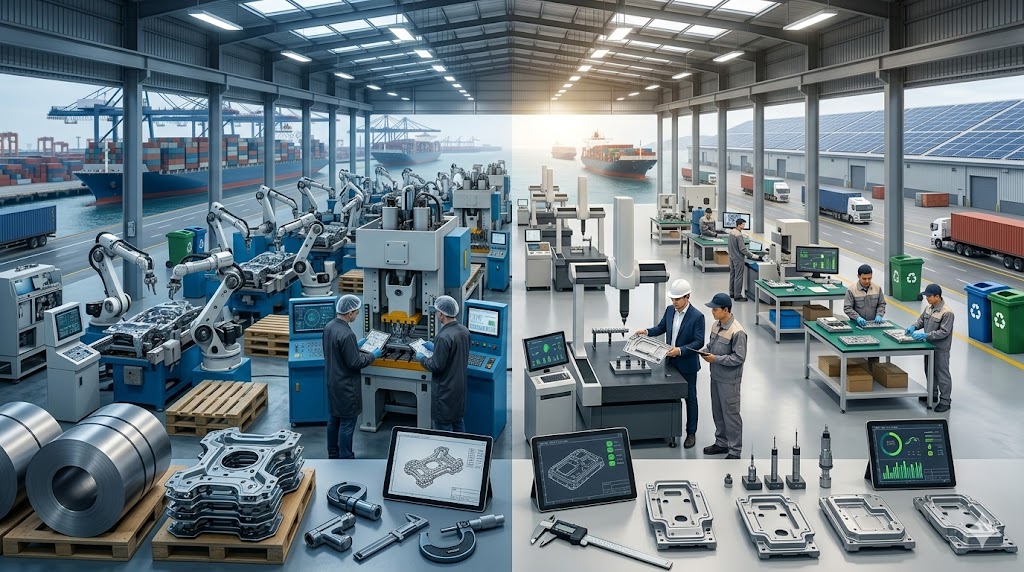
Vietnamese suppliers increasingly source from mills with improved electric arc furnace technology, renewable energy integration, and carbon footprint reporting systems. Furthermore, downstream metal forming facilities optimize energy consumption through modern stamping, rolling, and fabrication lines.
By integrating low-carbon steel into the supply chain, exporters not only meet EU requirements but also improve their ESG profile. Consequently, they become preferred suppliers for multinational corporations with sustainability mandates.
Vietnam’s Readiness for CBAM Compliance Vietnam
Vietnam’s industrial sector has evolved significantly over the past decade. Today, leading metal forming facilities operate under ISO 14001 environmental management systems and implement energy monitoring frameworks.
First, manufacturers are investing in digital carbon accounting tools. These systems track energy consumption per batch and per product category.
Second, factories are shifting toward rooftop solar and renewable grid contracts. As electricity represents a major emission source, this transition directly lowers embedded carbon intensity.
Third, engineering teams are optimizing production flow to minimize scrap rates and reduce rework. Lower material waste translates into measurable emission reductions.
Because of these improvements, CBAM Compliance Vietnam is achievable and increasingly standardized among export-oriented factories.
Why EU Buyers Choose CBAM Compliance Vietnam Suppliers
European procurement managers evaluate suppliers based on compliance, cost, and reliability. CBAM Compliance Vietnam addresses all three dimensions.
From a compliance perspective, verified emission reports reduce administrative risk. Buyers avoid penalties and unexpected certificate costs.
From a cost perspective, lower embedded emissions mean fewer CBAM certificates required after 2026. Therefore, total landed cost remains competitive compared to high-emission regions.
From a reliability perspective, Vietnam’s manufacturing ecosystem offers political stability, diversified trade agreements, and strong export logistics. These factors reinforce supply chain resilience.
CBAM Compliance Vietnam vs Other Asian Manufacturing Hubs
When comparing sourcing destinations, buyers increasingly assess regulatory readiness. Some countries still rely heavily on coal-intensive energy grids and lack transparent emission tracking systems.
Vietnam, by contrast, has demonstrated measurable progress in industrial decarbonization. While challenges remain, export-focused manufacturers are aligning quickly with EU frameworks.
For buyers evaluating alternatives, it is useful to review broader strategic comparisons.
Vietnam vs China
Vietnam vs China sourcing decisions in 2026 extend beyond tariffs and labor cost. China has strong production capacity; however, certain regions remain highly carbon-intensive. In contrast, Vietnam offers newer facilities with lower baseline emissions and growing renewable adoption.
For companies analyzing risk diversification, Vietnam vs China comparisons increasingly favor Vietnam when carbon compliance becomes a deciding factor.
Operational Steps to Achieve CBAM Compliance Vietnam
Achieving CBAM Compliance Vietnam requires a structured roadmap. Leading suppliers typically follow several key steps.
They begin with carbon footprint assessment at facility and product levels. Accurate data collection forms the foundation for EU reporting.
Next, they implement energy reduction strategies. This includes upgrading machinery, improving maintenance cycles, and introducing automation to enhance efficiency.
Subsequently, they secure documentation aligned with EU methodologies. Transparent reporting ensures that importers can submit accurate CBAM declarations.
Finally, they collaborate with EU clients to validate emission factors and refine reporting accuracy. This partnership approach builds trust and long-term contractual stability.
Industry Applications Impacted by CBAM Compliance Vietnam
CBAM Compliance Vietnam directly affects multiple industrial sectors.
Automotive manufacturers sourcing metal brackets, chassis components, and stamped assemblies must ensure emission transparency.
Construction and infrastructure firms importing fabricated steel structures also face reporting obligations.
Energy equipment producers, particularly in renewable sectors, must align supply chains with sustainability targets.
Therefore, compliant Vietnamese metal forming partners become strategic enablers across industries.
Cost Optimization Under CBAM Compliance Vietnam
Although compliance requires investment, it also unlocks cost efficiency. Energy-efficient equipment lowers operational expenses over time. Reduced scrap improves material yield. Renewable integration shields factories from volatile fossil fuel prices.
In addition, compliant suppliers often qualify for preferred vendor status with European corporations. This status increases order volume and stabilizes long-term revenue.
Thus, CBAM Compliance Vietnam is not merely a regulatory requirement. It is a competitive advantage that strengthens both pricing and market positioning.
Choosing the Right Partner for CBAM Compliance Vietnam
When evaluating Vietnamese suppliers, EU buyers should request detailed emission documentation. They should also verify environmental certifications and renewable energy initiatives.
Furthermore, site audits remain essential. On-site verification confirms that reported data aligns with actual production conditions.
An experienced engineering team adds further value. Technical optimization reduces carbon intensity while maintaining product quality and mechanical performance.
Ultimately, CBAM Compliance Vietnam depends on transparency, technical capability, and long-term strategic alignment.
Conclusion: Secure Your EU Market with CBAM Compliance Vietnam
The EU’s carbon regulation framework is reshaping global metal forming supply chains. Companies that adapt early will secure cost stability and regulatory certainty.
CBAM Compliance Vietnam provides EU importers with a clear pathway toward compliant, low-carbon sourcing. By leveraging low-carbon steel, renewable energy integration, and transparent reporting systems, Vietnamese manufacturers are prepared for the 2026 carbon cost environment.
If your organization exports to Europe or supplies EU-based clients, now is the time to strengthen your sourcing strategy.
Contact us today to discuss certified CBAM Compliance Vietnam solutions tailored to your industry and ensure your supply chain is fully prepared for Carbon tax 2026.