
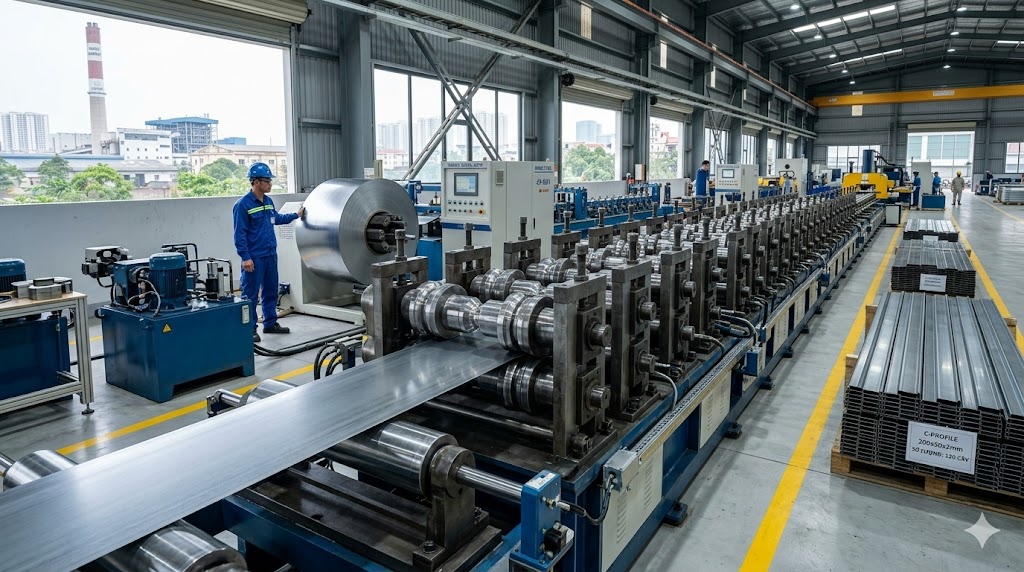
Cold Forming Vietnam plays a critical role in producing high-precision steel profiles for structural, automotive, and industrial applications. By shaping metal at room temperature through progressive roll stations, manufacturers achieve excellent dimensional consistency and enhanced strength characteristics. As global buyers demand tighter tolerances and improved surface integrity, cold roll technology has become a preferred manufacturing solution.
Unlike hot forming processes, Cold Forming Vietnam maintains the original metallurgical structure while increasing strength through strain hardening. Consequently, formed profiles exhibit improved yield performance without additional thermal treatment. This advantage makes the process highly efficient for projects that require durability, repeatability, and cost control.
In today’s competitive manufacturing environment, Vietnam offers scalable production, export-ready quality control systems, and integrated engineering expertise to support high-volume profile programs.
Why Cold Forming Vietnam Is Ideal for Precision Profiles
Cold roll forming gradually bends metal strip through a series of precisely engineered rollers. Because deformation occurs incrementally, the final geometry remains consistent across extended production runs. Therefore, profile accuracy improves while material waste decreases.
Moreover, the continuous process enables manufacturers to maintain high throughput without sacrificing quality. Contractors and OEMs benefit from reliable production timelines and uniform cross-sections, which are essential for assembly-line integration.
Cold Forming Vietnam is particularly suitable for:
- Structural reinforcement components
- Framing systems
- Automotive rails and brackets
- Electrical enclosures
- Industrial support channels
As industries shift toward lightweight yet stronger components, cold roll forming offers a practical balance between strength and cost efficiency.
Material Hardening Through Controlled Deformation
One of the primary technical advantages of cold forming lies in its ability to increase material strength without heat treatment.
Material hardening
Material hardening occurs naturally during cold deformation as the metal’s internal grain structure is compressed and realigned. This process enhances yield strength and stiffness while maintaining dimensional control.
By carefully managing roll pressure and pass design, manufacturers optimize structural integrity without compromising surface finish or tolerance requirements.
Controlled Strain Distribution
Proper roll tooling design distributes stress evenly along the strip width. Consequently, deformation remains predictable and distortion is minimized. Engineering simulations allow factories to pre-validate forming sequences before production begins.
Enhanced Structural Performance
As the material work-hardens, finished components often demonstrate improved load-bearing capacity. For construction and automotive applications, this mechanical enhancement translates into stronger yet lighter systems.
Precision Profiles for Industrial Applications
Consistency is essential when manufacturing profiles that must integrate seamlessly into larger assemblies.
Precision profiles
Precision profiles produced through Cold Forming Vietnam maintain strict dimensional tolerances across long production runs. Because rollers guide the strip progressively, cross-section geometry remains stable from the first piece to the last.
This repeatability reduces downstream rework and simplifies assembly processes for contractors and OEM buyers.
Tight Tolerance Control
Inline measurement systems monitor width, thickness, and profile alignment in real time. Operators can adjust roll positions instantly to maintain specification compliance.
Surface Integrity
Cold roll forming avoids thermal scaling, resulting in cleaner surfaces suitable for secondary finishing such as coating or painting.
Integration with Continuous Manufacturing Systems
Cold forming operates as part of a broader profile manufacturing ecosystem.
Roll Forming Vietnam
Roll Forming Vietnam encompasses the full spectrum of continuous profile production technologies. Cold forming represents a specialized method within this system, focused on precision cold working and enhanced mechanical performance.
Through integration with Roll Forming Vietnam capabilities, buyers access flexible tooling development, scalable output, and consistent export quality.
Technical Workflow of Cold Roll Forming
Understanding the production workflow clarifies why Cold Forming Vietnam remains a preferred solution for transactional buyers.
Coil Feeding and Straightening
Steel coils are loaded and straightened to eliminate residual curvature. Proper alignment at this stage ensures stable forming performance throughout the line.
Progressive Roll Stations
Multiple roll stands shape the strip incrementally. Each station performs a small deformation step, preventing excessive stress concentration.
Inline Punching and Cutting
For applications requiring holes or slots, synchronized punching modules operate without interrupting line speed. Flying cutoff systems then trim profiles to exact lengths.
Quality Inspection
Final inspection verifies dimensional tolerances, surface condition, and straightness. Documentation supports international export compliance.
Commercial Advantages for BOFU Buyers
Transactional buyers evaluate suppliers based on consistency, lead time, and technical capability. Cold Forming Vietnam offers competitive production costs combined with industrial-scale capacity.
Vietnam’s expanding industrial infrastructure supports high-volume output while maintaining quality control standards aligned with global markets. Additionally, skilled engineering teams provide tooling customization for project-specific profiles.
Because cold roll forming reduces scrap and eliminates secondary heat treatment, overall production efficiency improves. Therefore, buyers benefit from stable pricing and predictable delivery schedules.
Applications Across Industries
Cold roll formed profiles serve diverse sectors. Within the construction industry, they reinforce framing systems and structural channels, ensuring structural stability across large projects. Meanwhile, automotive manufacturers rely on them for seat tracks, bumper reinforcements, and chassis components where dimensional accuracy is critical. Industrial equipment producers also integrate these profiles as brackets and load-bearing frames to enhance mechanical performance.
Furthermore, renewable energy installations rely on precision cold formed rails and mounting structures. As infrastructure projects expand in 2026, demand for accurate, high-strength profiles continues to increase.
Future Development of Cold Forming Technology
Automation and digital monitoring enhance forming stability and repeatability. Servo-controlled adjustments allow rapid tooling changes, which support short production cycles for customized profiles.
In addition, manufacturers are investing in advanced simulation tools to refine roll pass design. These improvements reduce setup time and accelerate project onboarding for new customers.
Sustainability also influences production strategy. Because cold roll forming operates without large thermal input, energy consumption remains lower than many alternative shaping methods.
Conclusion
Cold Forming Vietnam delivers precision cold working solutions for structural and industrial profile manufacturing. Through controlled deformation and progressive roll tooling, manufacturers achieve material hardening and consistent dimensional accuracy without additional heat treatment.
For BOFU buyers seeking reliable production of precision profiles, Vietnam offers scalable capacity, competitive cost structures, and integrated Roll Forming Vietnam expertise. As demand for lightweight yet strong steel components grows in 2026, Cold Forming Vietnam remains a technically robust and commercially viable manufacturing solution.