
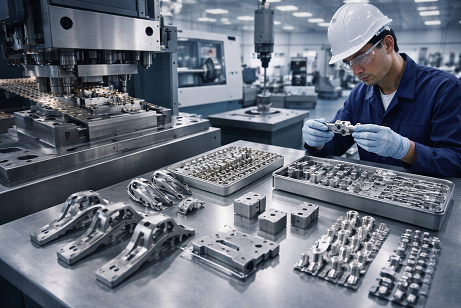
Critical Metal Forming in Vietnam has evolved into a strategic capability for industries where precision, traceability, and compliance are non-negotiable. Aerospace systems, medical devices, and advanced renewable technologies demand components that perform flawlessly under extreme conditions. Therefore, manufacturers must implement strict process control, certified quality systems, and advanced forming technologies to meet global standards.
Vietnam’s industrial landscape now supports Critical Metal Forming across high-spec fabrication projects. With increasing investment in certified facilities, automation, and engineering expertise, the country offers a commercially viable and technically capable solution for international OEMs operating at the mid-to-bottom funnel stage of procurement.
Critical Metal Forming for High-Reliability Industries
Critical Metal Forming refers to the production of metal components used in safety-critical and performance-sensitive applications. Unlike general industrial parts, these components must meet exacting dimensional tolerances, surface integrity standards, and mechanical strength requirements.
In aerospace and medical sectors, failure is not an option. Consequently, forming processes such as precision stamping, deep drawing, fine blanking, and CNC-assisted forming are tightly monitored. Manufacturers validate tooling geometry, material consistency, and forming parameters before approving serial production.
Vietnamese suppliers increasingly align operations with international quality certifications. Facilities serving aerospace clients implement AS9100 systems, while medical manufacturers adopt ISO 13485 frameworks. This alignment enhances global audit readiness and strengthens buyer confidence.
High-spec fabrication Capabilities in Vietnam
High-spec fabrication defines the advanced engineering and process discipline required for aerospace and medical components. Vietnamese manufacturers now operate precision presses, multi-axis machining centers, and automated inspection systems that meet demanding technical criteria.
Materials used in these sectors include stainless steel, titanium alloys, aluminum aerospace grades, and medical-grade alloys. Each material presents unique forming challenges. For example, titanium requires careful press force calibration to avoid micro-cracking, while thin stainless steel demands controlled spring-back compensation.
In addition, traceability systems track material batches from raw stock to final shipment. This structured documentation ensures compliance with aerospace and medical regulatory requirements.
By integrating high-spec fabrication with modern quality management, Vietnam supports projects that demand both performance and accountability.
Quality-first forming for Compliance and Safety
Quality-first forming emphasizes preventive process control rather than reactive correction. In critical industries, manufacturers must detect potential deviations before they affect product performance.
Vietnamese facilities implement advanced quality assurance tools such as coordinate measuring machines, optical inspection systems, and non-destructive testing. Statistical process control monitors tolerance variation in real time.
Furthermore, calibration schedules and tool maintenance protocols ensure consistent forming precision. Engineers conduct first article inspection and process validation prior to full-scale production.
This disciplined approach supports consistent output while minimizing risk. As a result, international buyers gain assurance that critical components meet strict regulatory and operational standards.
Aerospace Applications and Certified Production
Aerospace manufacturing demands structural integrity and lightweight optimization. Formed brackets, enclosures, structural clips, and airframe components must withstand vibration, pressure changes, and temperature extremes.
Vietnamese suppliers serving aerospace clients maintain controlled environments and detailed documentation. AS9100-aligned facilities verify dimensional accuracy and material properties before shipment.
For detailed capabilities in certified aerospace environments, explore Aerospace Stamping Vietnam solutions that focus on compliance-driven production and precision metal components.
Through certified operations and engineering collaboration, Vietnam supports aerospace programs requiring strict adherence to international standards.
Medical Device Manufacturing and Regulatory Standards
Medical applications require even higher levels of cleanliness and documentation. Surgical instruments, implantable device housings, and diagnostic equipment components must meet ISO 13485 standards.
Manufacturers implement controlled production zones and material traceability systems. Surface finishing processes are carefully managed to avoid contamination and ensure biocompatibility where required.
To understand dedicated capabilities in this field, review Medical Metal Forming solutions designed to meet healthcare industry standards.
By combining precision forming with regulatory discipline, Vietnam strengthens its position as a trusted supplier for medical OEMs.
Renewable Energy and Structural Forming
Although aerospace and medical industries represent core high-spec sectors, renewable energy applications also demand reliable forming processes. Solar mounting systems and wind turbine components must withstand environmental stress and long operational lifecycles.
For advanced projects in this sector, consider Renewable Energy Forming capabilities that integrate structural precision with corrosion-resistant materials.
This diversification demonstrates Vietnam’s ability to apply critical forming principles across multiple advanced industries.
Integration with Broader Industrial Applications
Critical industries often intersect with wider manufacturing ecosystems. Aerospace components may require connector terminals, shielding elements, or structural brackets produced through precision forming.
For a comprehensive overview of cross-industry capabilities, explore Metal Forming Applications in Vietnam. These case studies highlight how technical expertise transfers across sectors while maintaining compliance discipline.
Such integration allows buyers to consolidate multiple component categories under a unified supplier network.
Engineering Collaboration and DFM Strategy
Early-stage engineering collaboration reduces risk in critical metal forming projects. Vietnamese manufacturers increasingly engage in design for manufacturability consultations with international clients.
Simulation software validates forming feasibility and predicts stress distribution. Consequently, tooling modifications occur before physical production begins, minimizing costly revisions.
Prototype validation ensures that performance metrics align with final product requirements. By investing in collaborative planning, suppliers shorten development cycles and improve project outcomes.
Supply Chain Reliability and Export Readiness
Critical industries require stable supply chains. Vietnam offers political stability, expanding industrial infrastructure, and strong export connectivity.
Strategic trade agreements support cost optimization for global buyers. Meanwhile, structured documentation and compliance alignment simplify customs clearance and international audits.
Manufacturers maintain secure packaging and controlled logistics to protect high-value components during transit. This attention to detail reinforces reliability in demanding sectors.
Why Choose Vietnam for Critical Metal Forming
Several factors position Vietnam as a competitive destination for critical metal forming projects.
First, technical investment continues to grow in aerospace and medical-focused facilities. Skilled engineers and quality specialists support complex compliance requirements.
Second, cost efficiency remains attractive compared to mature manufacturing hubs, while performance standards align with global expectations.
Third, scalability enables suppliers to support both low-volume precision runs and higher-volume production programs.
Most importantly, quality-first forming practices ensure that safety-critical components meet exacting performance criteria.
Conclusion
Critical Metal Forming in Vietnam supports aerospace, medical, and renewable energy industries with high-spec fabrication and disciplined quality control. Through certified facilities, engineering collaboration, and structured compliance systems, Vietnamese manufacturers deliver components designed for safety-critical environments.
As global OEMs seek reliable, diversified supply chains, Vietnam offers a balanced combination of technical competence, regulatory alignment, and commercial viability. Companies evaluating high-reliability forming projects should consider Vietnam as a strategic partner capable of meeting stringent aerospace and medical standards.
Contact a qualified Vietnamese manufacturer today to discuss technical specifications, certification requirements, and project timelines for your next critical metal forming initiative.