
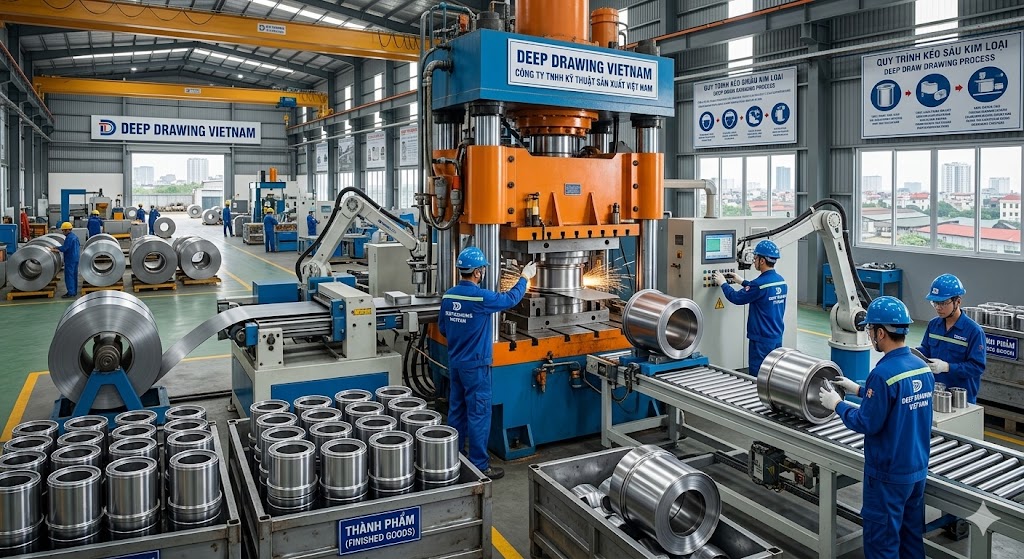
Deep Drawing Vietnam has emerged as a strategic solution for OEMs seeking seamless, high-precision metal components. As global manufacturing standards become stricter, companies increasingly require forming processes that deliver dimensional stability, structural integrity, and consistent repeatability.
In this context, Deep Drawing Vietnam provides advanced capabilities supported by modern presses, precision tooling, and structured quality systems. Moreover, Vietnam’s expanding industrial ecosystem enables suppliers to support both mid-volume and large-scale production programs efficiently.
Why Deep Drawing Vietnam Is Gaining Global Recognition
Deep drawing is a forming process that transforms flat metal blanks into hollow or cylindrical shapes through controlled mechanical force. Unlike conventional bending or stamping, this method produces seamless components with improved strength distribution.
Because seamless construction eliminates welding joints, structural reliability increases significantly. Furthermore, reduced secondary processing lowers overall production cost. Consequently, global OEMs in automotive, electronics, and energy sectors are turning to Deep Drawing Vietnam as a reliable sourcing option.
In addition, Vietnam offers competitive labor costs and strong export infrastructure. Therefore, buyers benefit from both technical capability and commercial efficiency.
Technical Foundations of Deep Drawing Vietnam
Successful deep drawing depends on precise control over materials, tooling, and press parameters. For that reason, professional suppliers invest heavily in engineering validation before production begins.
Material Preparation and Blank Optimization
Material characteristics directly affect forming performance. Thickness variation, tensile strength, and elongation rates must be analyzed carefully. Before forming starts, incoming coils undergo inspection to ensure compliance with specifications.
Proper blank sizing is equally critical. If the blank diameter is incorrect, wrinkling or tearing may occur. As a result, simulation tools are often used to predict material flow and optimize blank geometry.
Tooling Engineering and Process Simulation
Precision dies determine final geometry and surface finish. Advanced CAD/CAM systems allow engineers to simulate draw depth, corner radius behavior, and lubrication impact before tool fabrication.
By identifying potential deformation risks early, manufacturers reduce costly trial adjustments. Consequently, time-to-market shortens and production stability improves.
Press Control and Monitoring Systems
Hydraulic presses provide adjustable forming pressure, which is essential for complex shapes. Meanwhile, mechanical presses support higher cycle speeds for suitable applications.
Real-time monitoring systems track stroke consistency and pressure distribution. Therefore, deviations are detected quickly and corrected before defects accumulate.
Cylinder Applications in Deep Drawing Vietnam
Cylindrical structures are widely used in battery housings, exhaust components, and industrial casings. Seamless geometry enhances pressure resistance and mechanical durability.
Cylinder forming
Cylinder forming enables the production of uniform cylindrical parts with controlled wall thickness and minimal deformation. In many cases, this method reduces the need for welding, which improves structural integrity.
Moreover, precise draw depth control ensures consistent dimensional accuracy. As a result, finished components meet strict OEM tolerance requirements.
Box Structures and Enclosure Solutions
Rectangular and square enclosures require balanced material flow during forming. Without proper die design, corner thinning may occur.
Metal box fabrication
Metal box fabrication through deep drawing technology allows manufacturers to produce seamless enclosures with reinforced corners. In addition, trimming and piercing operations can be integrated within the same production sequence.
This integrated approach improves surface quality and reduces overall production time.
Integration with the Broader Manufacturing Ecosystem
Deep drawing functions most effectively when integrated with complementary forming processes.
Metal Forming Vietnam
Metal Forming Vietnam encompasses stamping, bending, rolling, and specialized forming technologies. Deep Drawing Vietnam represents a focused capability within this broader ecosystem.
By working within a unified Metal Forming Vietnam framework, buyers can consolidate operations and streamline supplier coordination. Consequently, project management becomes more efficient and risk exposure decreases.
Lightweight Engineering Through Aluminum
Weight reduction is a key objective in automotive and electronic systems. Aluminum components help achieve this goal without sacrificing structural strength.
Aluminum Forming Vietnam
Aluminum Forming Vietnam supports lightweight deep drawn components designed for performance-driven applications. Because aluminum exhibits different forming behavior compared to steel, suppliers apply specialized lubrication and controlled pressure settings.
Therefore, dimensional accuracy and surface finish remain consistent throughout production cycles.
High-Strength Solutions with Stainless Steel
Certain applications require superior corrosion resistance and durability.
Stainless Steel Forming
Stainless Steel Forming in Vietnam addresses export-quality demands for medical equipment, food processing systems, and marine environments. Due to higher work hardening characteristics, stainless steel requires precise draw ratio control.
However, with optimized tooling and process calibration, manufacturers achieve reliable repeatability and strong structural performance.
Heavy Gauge Production Using Hydraulic Press Technology
Some industrial programs involve thicker materials and higher forming forces. Mechanical presses may not provide sufficient control for these applications.
Hydraulic Press Forming
Hydraulic Press Forming enables gradual pressure distribution, which is essential for heavy gauge components. In addition, adjustable stroke speed improves material flow stability.
Consequently, larger and structurally robust components can be produced without compromising dimensional consistency.
Quality Assurance in Deep Drawing Vietnam
Consistent quality requires multi-stage verification. Inspection does not occur only at final stages; instead, it is embedded throughout production.
During forming, operators conduct dimensional checks at defined intervals. Meanwhile, automated sensors monitor press parameters continuously. If deviations appear, corrective action is implemented immediately.
Before shipment, finished components undergo final dimensional verification and surface inspection. When required, suppliers provide material certificates and inspection documentation. As a result, customers gain confidence in product conformity.
Commercial Advantages and Supply Chain Benefits
Cost competitiveness remains an important factor in sourcing decisions. Nevertheless, technical reliability and delivery stability are equally critical.
Vietnam benefits from favorable trade agreements and expanding logistics infrastructure. Therefore, export processes are streamlined for North American and European markets.
Moreover, engineering responsiveness allows faster project adjustments when design modifications occur. In contrast to less flexible supply chains, Vietnamese manufacturers often provide quicker technical communication and adaptation.
Future Outlook of Deep Drawing Vietnam
Industrial transformation continues across Southeast Asia. Automation investment and digital quality monitoring are becoming more widespread.
At the same time, electrification and renewable energy growth increase demand for seamless cylindrical and enclosure components. Consequently, Deep Drawing Vietnam is expected to expand its role in high-value industrial supply chains.
Conclusion
Deep Drawing Vietnam delivers specialized forming capabilities supported by advanced tooling, precision press control, and integrated manufacturing systems. Through cylinder forming and metal box fabrication expertise, suppliers provide reliable solutions for global OEMs.
Furthermore, integration with the broader Metal Forming Vietnam ecosystem enhances flexibility and efficiency. For companies seeking technically capable and commercially competitive forming partners, Vietnam represents a strong and sustainable option.