
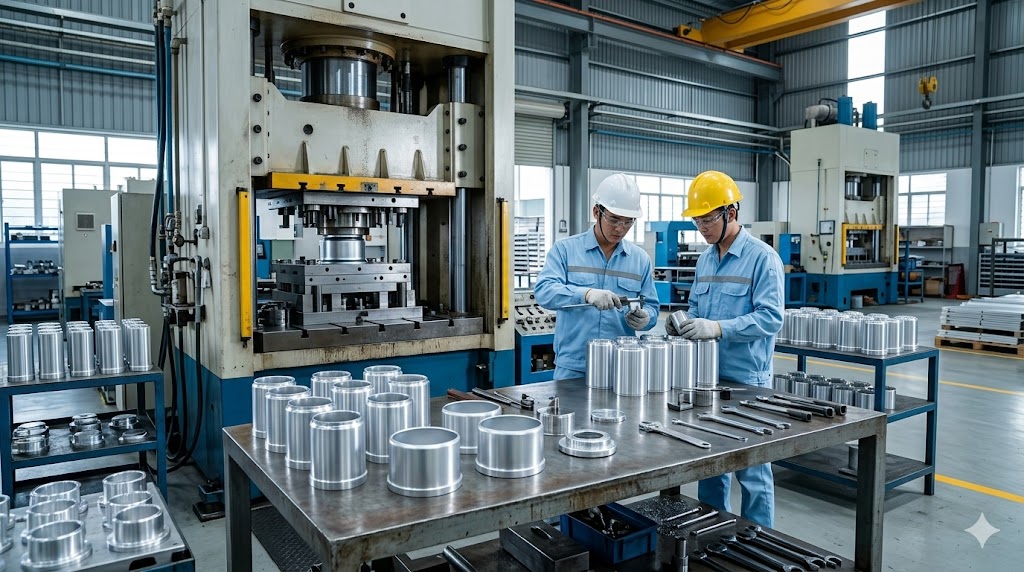
Aluminum Forming Vietnam has become a preferred solution for OEMs seeking lightweight, corrosion-resistant, and high-precision components. As industries shift toward electrification, energy efficiency, and weight reduction, aluminum deep drawing plays a critical role in modern product design.
Through advanced press systems, precision tooling, and controlled surface treatment processes, Aluminum Forming Vietnam delivers consistent quality for demanding export markets. Moreover, manufacturers in Vietnam increasingly integrate forming, trimming, machining, and finishing into a streamlined production workflow. As a result, buyers benefit from reduced lead times and improved supply chain coordination.
Why Aluminum Forming Vietnam Is Strategic for Lightweight Engineering
Aluminum offers an excellent strength-to-weight ratio, natural corrosion resistance, and strong thermal conductivity. Therefore, it is widely used in automotive battery systems, electronics housings, HVAC components, and industrial enclosures.
Unlike conventional stamping, deep drawing aluminum requires precise control over draw ratios and lubrication. Because aluminum behaves differently from steel, forming parameters must be optimized carefully. Consequently, experienced suppliers invest in simulation software and in-house die design to ensure dimensional stability.
Aluminum Forming Vietnam combines technical capability with cost competitiveness. In addition, Vietnam’s strong export infrastructure supports reliable global shipments to North America and Europe.
Deep Drawing Process in Aluminum Forming Vietnam
The deep drawing process transforms flat aluminum blanks into seamless cylindrical or box-shaped components. However, successful forming depends on multiple technical variables.
Material Selection and Blank Preparation
Aluminum alloys vary significantly in tensile strength and elongation properties. For that reason, suppliers carefully select alloys such as 1050, 3003, or 5052 depending on the final application.
Before forming begins, blank dimensions are optimized to prevent wrinkling or tearing. Furthermore, surface cleanliness is maintained to ensure smooth material flow during the draw process.
Tooling Design and Process Simulation
Precision dies define part geometry and wall thickness distribution. By using CAD/CAM systems and forming simulations, engineers predict material behavior before tool fabrication.
This proactive engineering approach minimizes trial adjustments. As a result, tooling life improves and scrap rates decrease.
Press Technology and Force Control
Hydraulic presses are commonly used in Aluminum Forming Vietnam operations because they allow adjustable pressure and controlled draw speed. Meanwhile, mechanical presses support higher production volumes when geometry permits.
Real-time monitoring systems track stroke depth and pressure consistency. Therefore, forming deviations can be corrected immediately, which enhances repeatability.
Surface Treatment and Functional Finishing
Aluminum components often require surface enhancement to improve corrosion resistance and aesthetics.
Anodized finish
Anodized finish is frequently applied to deep drawn aluminum parts to increase surface hardness and corrosion resistance. In addition, anodizing improves wear performance and provides decorative color options for visible components.
Within Aluminum Forming Vietnam supply chains, anodizing processes are tightly controlled to ensure uniform coating thickness and consistent appearance.
Structural Applications and Aluminum Enclosures
Deep drawn aluminum is widely used for protective housings and structural shells.
Aluminum enclosures
Aluminum enclosures produced through deep drawing provide seamless construction and improved structural integrity. Because the process eliminates weld joints, mechanical strength and appearance both improve.
Manufacturers integrate trimming, piercing, and surface finishing to deliver ready-to-assemble enclosure solutions for electronics, battery modules, and industrial control systems.
Industry Applications of Aluminum Forming Vietnam
Aluminum deep drawing supports multiple high-growth sectors.
Automotive and EV Systems
Electric vehicles require lightweight battery casings and thermal management components. Aluminum Forming Vietnam enables consistent wall thickness and structural stability in these critical applications.
Moreover, reduced component weight improves overall vehicle efficiency. Consequently, OEMs increasingly source aluminum forming solutions from Vietnam.
Electronics and Consumer Products
Electronic housings require precision tolerances and clean surface finishes. Deep drawn aluminum components offer both durability and aesthetic appeal.
Furthermore, anodized surfaces enhance corrosion resistance, which extends product lifespan.
Industrial Equipment and HVAC
Industrial enclosures and HVAC components benefit from aluminum’s thermal conductivity and corrosion resistance. Through controlled forming processes, manufacturers achieve consistent geometry across production batches.
Integration with Advanced Deep Drawing Solutions
Aluminum deep drawing is part of a broader forming ecosystem.
Deep Drawing Vietnam encompasses specialized forming capabilities for cylindrical and enclosure-type components across multiple materials. Aluminum Forming Vietnam represents a focused segment within this broader capability.
By leveraging Deep Drawing Vietnam expertise, buyers gain access to advanced engineering, simulation-driven tooling, and integrated production workflows.
Quality Control in Aluminum Forming Vietnam
Maintaining dimensional stability and surface integrity is essential in BOFU-stage production programs.
In-Process Inspection
Operators conduct dimensional verification at defined production intervals. Meanwhile, automated systems monitor press parameters continuously.
If deviations are detected, corrective action is implemented immediately. Therefore, consistency is maintained across high-volume runs.
Final Validation and Documentation
Before shipment, parts undergo visual inspection and dimensional measurement. When required, suppliers provide material certificates and surface treatment documentation to support export compliance.
These structured quality procedures ensure reliability for global OEM partnerships.
Commercial Advantages for Global Buyers
Cost efficiency remains important; however, technical reliability defines long-term supplier value.
Vietnam benefits from trade agreements such as CPTPP and EVFTA, which reduce tariff exposure. Additionally, growing industrial clusters strengthen local supply chain integration.
Engineering responsiveness also plays a key role. When design modifications occur, suppliers can adapt tooling and process parameters efficiently. Consequently, production continuity is preserved.
Future Outlook of Aluminum Forming Vietnam
Lightweight engineering will continue to expand as industries pursue energy efficiency and sustainability targets. Therefore, demand for deep drawn aluminum components is expected to grow steadily.
Vietnam’s investment in automation, digital process monitoring, and workforce training strengthens its position in advanced manufacturing. As a result, Aluminum Forming Vietnam is evolving from a cost-driven option into a technically mature production hub.
Conclusion
Aluminum Forming Vietnam delivers high-performance deep drawn components designed for lightweight, corrosion-resistant, and structurally stable applications. Through advanced tooling, hydraulic press control, anodized finishing, and integrated enclosure fabrication, Vietnamese manufacturers support demanding OEM requirements.
For companies seeking reliable, export-ready aluminum forming solutions, Vietnam offers both engineering capability and commercial competitiveness.