
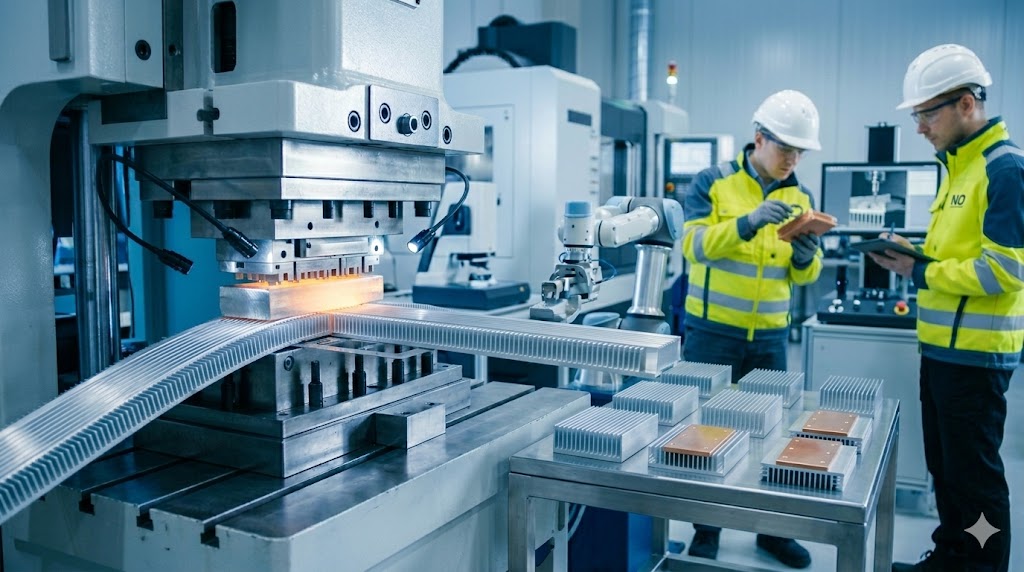
Heat Sink Forming in Vietnam has become a critical capability for OEMs seeking reliable thermal management solutions in electronics, automotive, and industrial systems. As power density increases and device miniaturization accelerates, effective heat control directly influences performance, safety, and product lifespan. Therefore, manufacturers must rely on precision forming and extrusion processes that ensure optimal thermal efficiency and structural stability.
Vietnam’s manufacturing ecosystem now supports advanced Heat Sink Forming solutions through integrated extrusion lines, CNC machining, stamping, and secondary finishing. With competitive production costs and expanding technical expertise, the country offers a strong transactional advantage for global buyers at the decision-making stage.
Heat Sink Forming for Advanced Thermal Management
Heat Sink Forming involves shaping conductive metals into geometries that maximize surface area and airflow. Because modern electronic components generate concentrated heat loads, properly engineered heat sinks are essential for stable operation.
Vietnamese manufacturers utilize aluminum extrusion, CNC milling, stamping, and bending technologies to produce customized cooling components. In addition, automated cutting and precision drilling ensure tight dimensional tolerances.
Moreover, design flexibility enables engineers to optimize fin density, thickness, and spacing according to thermal modeling data. This approach improves convection efficiency while maintaining mechanical durability.
As global markets demand faster production cycles, suppliers in Vietnam increasingly combine extrusion and forming processes within a single facility. Consequently, buyers benefit from shorter lead times and streamlined communication.
Material Selection and Process Engineering
Material choice significantly affects Heat Sink Forming performance. Aluminum alloys such as 6063 and 6061 remain popular due to their excellent thermal conductivity, lightweight properties, and corrosion resistance.
However, certain high-power applications require alternative materials to enhance heat transfer rates.
Aluminum Extrusion Capabilities
Extrusion allows manufacturers to create continuous profiles with complex fin structures. Once extruded, profiles are cut to length and undergo secondary machining operations.
Vietnamese facilities operate modern extrusion presses with precise temperature and pressure control. As a result, material grain structure remains consistent, supporting both strength and conductivity.
Secondary processes such as anodizing and powder coating improve corrosion resistance and surface protection. Although coatings slightly affect thermal conductivity, controlled thickness ensures performance remains within design specifications.
Precision Stamping and Secondary Forming
For compact devices, thin-gauge stamped heat spreaders complement extruded sinks. Progressive dies enable high-volume production while maintaining geometric accuracy.
Furthermore, hybrid designs often integrate stamped brackets with extruded bases. This combination enhances mounting stability and airflow optimization.
Optimizing Thermal dissipation in Electronics
Thermal dissipation defines the primary performance objective of any heat sink design. Without effective heat removal, semiconductor devices experience performance degradation and potential failure.
Vietnamese manufacturers collaborate with OEM engineers to align forming geometry with computational thermal simulations. This collaborative approach ensures that fin layout, base thickness, and airflow direction support optimal cooling efficiency.
Additionally, surface finishing techniques such as skiving and micro-fin cutting increase surface area without significantly increasing weight. Consequently, compact systems achieve higher cooling performance within limited space.
Testing procedures validate thermal performance under simulated operating conditions. Manufacturers conduct temperature cycling, airflow testing, and load validation before approving mass production.
Advanced Copper forming for High-Power Applications
Copper forming becomes essential when applications demand superior thermal conductivity. Copper offers higher heat transfer rates compared to aluminum; however, it requires specialized tooling and process control.
Vietnamese suppliers increasingly invest in high-tonnage presses and precision bending equipment capable of handling copper alloys. Because copper exhibits different mechanical behavior, engineers adjust forming parameters to prevent cracking or work hardening.
In some cases, manufacturers produce hybrid aluminum-copper assemblies. These designs combine copper heat spreaders with aluminum fins to balance cost and performance.
Through careful process engineering, suppliers maintain dimensional stability while maximizing thermal conductivity.
Industry Applications of Heat Sink Forming
Heat Sink Forming in Vietnam supports diverse industries.
In consumer electronics, compact heat sinks regulate processor temperatures in laptops and gaming systems. Automotive electronics use formed cooling components to manage heat in electric vehicle control modules and battery systems.
Industrial automation systems require reliable cooling for power inverters and motor drives. Meanwhile, telecommunications equipment depends on efficient heat removal to maintain signal integrity in high-frequency networks.
Each sector presents unique environmental conditions, including vibration, humidity, and temperature variation. Therefore, manufacturers design forming solutions that ensure long-term reliability under operational stress.
Integration with Electronics Manufacturing
Heat sink components function within a broader electronics production ecosystem.
For related precision manufacturing capabilities, explore Electronics Metal Forming solutions that support connectors, shielding components, and micro-stamped parts within electronic assemblies.
By integrating multiple metal forming processes under one supplier network, OEMs reduce procurement complexity and improve quality consistency across product lines.
Quality Control and Dimensional Accuracy
Consistent quality defines successful Heat Sink Forming projects. Manufacturers in Vietnam implement structured quality management systems aligned with ISO 9001 standards.
Incoming raw material inspection verifies alloy composition and dimensional accuracy. During extrusion and forming, in-process measurement tools monitor profile geometry and surface integrity.
CNC coordinate measuring machines validate final dimensions before shipment. Additionally, surface finish inspections confirm coating thickness and anodizing consistency.
Through statistical process control, suppliers detect variation early and implement corrective actions. This disciplined approach minimizes defect rates and protects production schedules.
Cost Efficiency and Supply Chain Advantages
Vietnam provides a balanced cost-performance proposition. Labor costs remain competitive compared to mature manufacturing hubs, while technical capabilities continue to advance.
Strategic trade agreements enhance export competitiveness to North America and Europe. As tariffs decrease, total landed cost improves without sacrificing quality.
Furthermore, stable political conditions and expanding industrial infrastructure strengthen supply chain resilience. Buyers seeking diversification benefit from Vietnam’s reliable export ecosystem.
Scalability also supports rapid production ramp-up. Whether launching new product lines or increasing volume, suppliers adjust capacity while maintaining precision standards.
Engineering Collaboration and Custom Design
Successful Heat Sink Forming projects often begin with early engineering engagement. Vietnamese manufacturers provide design for manufacturability consultation to optimize geometry and reduce production cost.
Thermal modeling software assists in validating airflow and conduction performance before tooling fabrication. This proactive planning reduces revision cycles and shortens development timelines.
Moreover, prototype production enables performance verification prior to full-scale manufacturing. Buyers gain confidence in both technical capability and process reliability.
Why Source Heat Sink Forming in Vietnam
Several strategic factors position Vietnam as a strong sourcing destination.
Technical investment in extrusion presses and CNC systems continues to grow. Skilled engineers support international communication and documentation requirements.
Compliance with environmental and material safety standards meets global regulatory expectations. At the same time, competitive pricing supports margin optimization.
Most importantly, manufacturers demonstrate responsiveness and collaborative project management. This reliability supports long-term partnerships in high-volume electronics production.
Conclusion
Heat Sink Forming in Vietnam delivers precision extrusion and fabrication solutions designed for effective thermal management across advanced electronic systems. With strong material expertise, compliance alignment, and cost efficiency, Vietnamese manufacturers provide reliable cooling components for global OEMs.
As electronic systems become more powerful and compact, robust thermal solutions become indispensable. Companies seeking transactional-ready suppliers should evaluate Vietnam as a strategic partner capable of delivering scalable, high-performance Heat Sink Forming solutions.
Contact a qualified manufacturer today to discuss technical specifications, material options, and production timelines for your next heat sink project.