
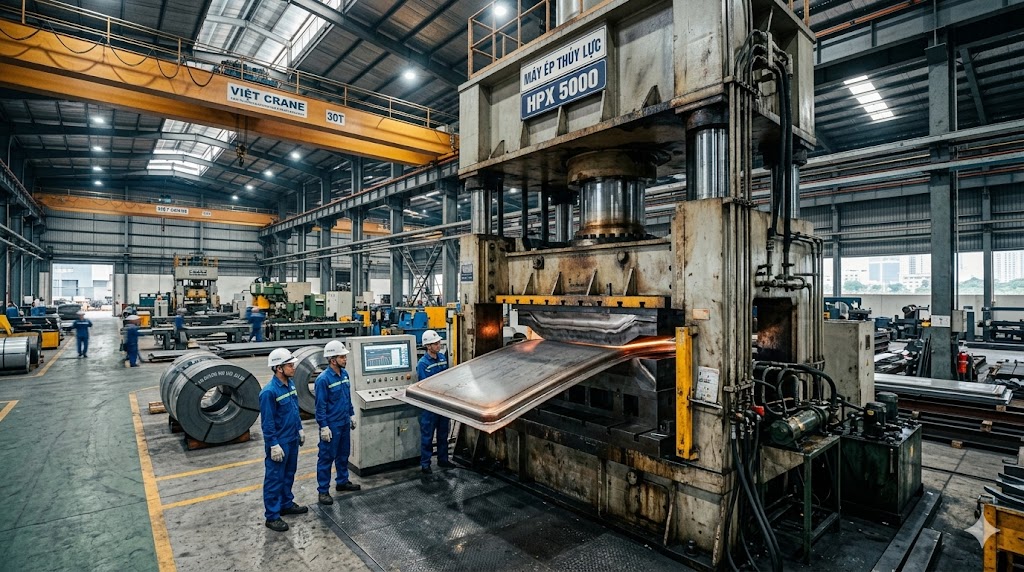
Hydraulic Press Forming in Vietnam provides a reliable solution for OEMs requiring heavy gauge, high-strength, and large-dimension metal components. As industrial products grow in size and structural demands increase, manufacturers must rely on controlled forming force and stable deformation processes. In this context, hydraulic press technology offers precision, flexibility, and repeatable performance.
Vietnamese suppliers have expanded their hydraulic forming capabilities to serve automotive, energy, infrastructure, and heavy industrial sectors. Moreover, integrated engineering teams support tooling design, process simulation, and quality control, ensuring consistent results across medium and high-volume programs.
Why Hydraulic Press Forming Is Critical for Heavy Gauge Manufacturing
Hydraulic press systems allow adjustable pressure distribution throughout the forming stroke. Unlike purely mechanical presses, hydraulic machines provide smoother force application and better control over draw depth. Therefore, complex shapes and thick materials can be formed without excessive stress concentration.
Heavy gauge materials often require higher forming tonnage and slower, controlled deformation. Consequently, Hydraulic Press Forming becomes essential when working with structural steel, stainless steel, or aluminum plates exceeding standard sheet thickness.
In addition, programmable pressure settings enable precise adjustment during production runs. As a result, dimensional stability improves and scrap rates decrease.
Technical Capabilities in Hydraulic Press Forming
Hydraulic forming processes rely on coordinated control between tooling, press force, and material characteristics. Each element influences final product quality.
Tooling Design and Structural Support
Tooling must withstand high forming loads while maintaining alignment accuracy. Engineers use reinforced die sets and precision-machined guiding systems to ensure stability during heavy press cycles.
Simulation software predicts stress distribution across large surface areas. By identifying potential thinning zones early, manufacturers reduce the risk of cracking or distortion.
Controlled Tonnage and Stroke Management
Hydraulic systems allow operators to regulate tonnage throughout the entire stroke. This flexibility supports multi-stage forming processes and complex geometries.
Furthermore, pressure sensors continuously monitor force application. If deviations occur, adjustments can be implemented immediately. Consequently, consistency is maintained across production batches.
Integration with Trimming and Secondary Operations
After forming, components often require trimming, piercing, or reinforcement. Vietnamese facilities frequently integrate these operations within the same production line.
By combining forming and finishing steps, lead time shortens and handling errors are minimized.
Applications of Hydraulic Press Forming in Large Industrial Projects
Heavy-duty industrial programs often require structural parts capable of withstanding mechanical loads and environmental stress.
Large format metal
Large format metal components such as structural panels, equipment bases, and machine housings require stable forming force across extended surface areas. Hydraulic press systems distribute pressure evenly, which prevents warping or uneven thickness.
This capability enables the production of oversized components used in transportation, construction, and industrial machinery sectors.
Deep draw capacity
Deep draw capacity is essential when forming thick or high-strength materials into cylindrical or enclosure-type geometries. Hydraulic press technology allows gradual deformation, which reduces tearing risk and improves wall thickness control.
As a result, manufacturers can produce deep drawn parts with improved structural integrity and surface quality.
Integration with Advanced Deep Drawing Expertise
Hydraulic forming is closely connected to broader deep drawing capabilities.
Deep Drawing Vietnam
Deep Drawing Vietnam represents the specialized forming ecosystem that supports cylindrical and enclosure-type components across multiple materials and thicknesses. Hydraulic Press Forming enhances this ecosystem by enabling heavy gauge and high-tonnage applications.
By leveraging Deep Drawing Vietnam expertise, OEMs gain access to simulation-driven tooling, controlled deformation strategies, and integrated quality management systems.
Industry Sectors Benefiting from Hydraulic Press Forming
Several industries rely heavily on controlled high-tonnage forming processes.
Energy and Infrastructure
Energy systems require durable housings, structural enclosures, and pressure-resistant components. Hydraulic forming provides the necessary control to shape thick materials without compromising integrity.
Automotive and Commercial Vehicles
Heavy-duty vehicle platforms utilize reinforced panels and structural components. Hydraulic Press Forming supports these applications by delivering consistent thickness distribution and dimensional precision.
Industrial Equipment Manufacturing
Machine frames, base plates, and reinforced housings demand both strength and dimensional stability. Through controlled pressure application, manufacturers achieve reliable geometry even in large components.
Quality Control and Process Assurance
High-tonnage forming requires strict inspection protocols. Without precise monitoring, dimensional deviation may occur under heavy loads.
In-Process Monitoring
Sensors measure pressure distribution and stroke accuracy in real time. Operators conduct scheduled dimensional checks to verify geometry consistency.
Because heavy gauge materials react differently under stress, continuous monitoring is essential. Therefore, production stability improves through data-driven control.
Final Inspection and Export Compliance
Before shipment, finished parts undergo dimensional verification and surface inspection. When required, material certificates and inspection documentation accompany export orders.
Structured quality systems ensure long-term reliability and build trust with international partners.
Commercial Advantages of Hydraulic Press Forming Vietnam
Cost competitiveness remains an important consideration; however, engineering reliability determines project success. Vietnam combines growing technical capability with favorable labor structures and export agreements.
Trade frameworks such as CPTPP and EVFTA enhance international market access. Moreover, expanding industrial clusters allow efficient coordination between forming, machining, and finishing processes.
Because suppliers can adapt tooling and press parameters quickly, project modifications are managed without significant disruption. Consequently, OEMs benefit from stable production and predictable timelines.
Future Outlook of Hydraulic Press Forming in Vietnam
Industrial demand for large and heavy structural components continues to increase. Electrification, renewable energy expansion, and infrastructure development are key growth drivers.
Vietnam’s investment in modern hydraulic press equipment and digital monitoring technologies strengthens its competitive position. As automation and simulation tools advance, forming accuracy and efficiency will continue to improve.
Hydraulic Press Forming is therefore evolving into a high-value manufacturing capability within Vietnam’s broader metal forming sector.
Conclusion
Hydraulic Press Forming in Vietnam delivers reliable heavy gauge and large format metal solutions for demanding industrial applications. Through controlled tonnage, reinforced tooling, advanced deep draw capacity, and integrated quality management, Vietnamese manufacturers support global OEM production requirements.
For companies seeking high-tonnage forming capability combined with engineering expertise and commercial competitiveness, Vietnam provides a scalable and technically mature manufacturing partner.