
Metal Forming Vietnam has emerged as a strategic manufacturing solution for global OEMs and Tier 1 suppliers seeking cost efficiency, engineering precision, and supply chain resilience. As global sourcing patterns shift in 2026, Vietnam continues to strengthen its position in sheet metal forming, high-volume stamping, and engineered profile production.
This guide provides a comprehensive overview of Vietnam’s metal forming landscape, core technologies, supplier capabilities, cost structures, and competitive advantages compared to China, India, and Mexico. It is designed for procurement managers, supply chain directors, and engineering teams evaluating long-term production partnerships in Southeast Asia.
Why Metal Forming Vietnam Is Gaining Global Attention
Over the past decade, Vietnam has transitioned from a low-cost assembly base to a regional precision manufacturing hub. Several structural drivers explain this growth.
First, labor costs remain competitive while technical skill levels continue to improve. Second, industrial zones near Ho Chi Minh City, Hanoi, and Hai Phong offer strong infrastructure and export logistics. Third, trade agreements such as CPTPP and EVFTA provide tariff advantages for Western buyers.
Moreover, manufacturers increasingly prioritize risk diversification. As a result, Vietnam supply chain development has accelerated, particularly in supporting industries such as tooling, surface treatment, and CNC machining. This ecosystem integration reduces dependency on single-country sourcing strategies.
Core Capabilities in Metal Forming Vietnam
Metal forming processes in Vietnam cover a wide spectrum of industrial applications. These processes support automotive components, agricultural equipment, construction hardware, electronics housings, and heavy machinery parts.
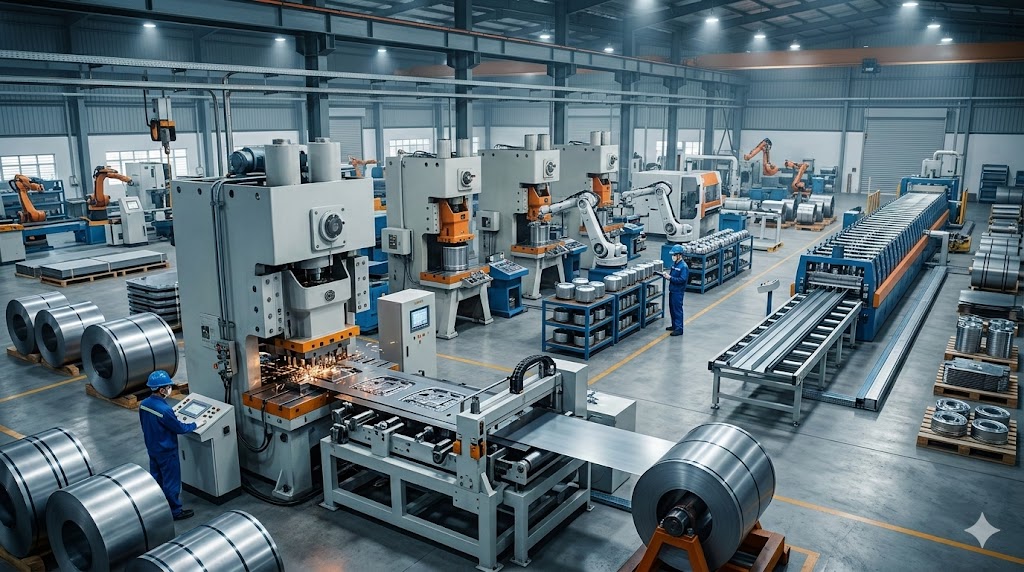
Key technologies include progressive stamping, deep drawing, roll forming, press brake bending, laser cutting, and precision tooling fabrication. Many factories now operate servo-driven stamping presses, automated feeding systems, and in-line inspection equipment.
In addition, quality systems have improved significantly. ISO 9001 certification is standard. For automotive and export markets, IATF 16949 compliance is increasingly common. Furthermore, factories serving EU markets often meet RoHS and REACH requirements.
Engineering Strength and Precision Manufacturing Standards
Precision manufacturing is no longer optional in global supply chains. It determines product reliability, tolerance consistency, and lifecycle durability.
Vietnamese metal forming factories increasingly invest in CAD/CAM design, simulation software, and die engineering capabilities. Tooling accuracy directly impacts production repeatability. Consequently, experienced toolmakers play a central role in high-volume programs.
Dimensional inspection frequently relies on CMM measurement, optical scanning, and statistical process control. These measures ensure consistency across batches and reduce rejection rates.
Additionally, many manufacturers provide DFM consultation before mass production. This collaborative engineering approach improves part manufacturability while lowering total production cost.
Vietnam Supply Chain Integration and Export Infrastructure
Vietnam supply chain performance has improved significantly due to industrial clustering and foreign direct investment.
Major ports such as Hai Phong and Cat Lai enable efficient shipping to North America and Europe. Lead times remain competitive compared to regional alternatives. In parallel, logistics providers offer multimodal transport and bonded warehouse solutions.
Supplier networks have also expanded. Local providers now supply steel coils, aluminum sheets, zinc-coated materials, and secondary processes such as powder coating and plating. While certain specialty materials may still require import, overall localization continues to improve.
Furthermore, government policies encourage supporting industries. Incentives in industrial parks help accelerate ecosystem development around key manufacturing zones.
Cost Structure and Competitive Positioning in 2026
Cost remains a major decision factor in global sourcing. However, buyers increasingly evaluate total landed cost rather than unit price alone.
In Metal Forming Vietnam operations, labor costs are typically lower than China’s coastal regions. Meanwhile, operational overhead remains moderate compared to developed economies. Electricity and facility expenses remain stable in most industrial areas.
Tooling investment is competitive, particularly for progressive dies and transfer dies. Furthermore, long-term production programs benefit from lower maintenance costs due to experienced technical teams.
When comparing Vietnam to India or Mexico, Vietnam often offers shorter transit times to Asian suppliers and efficient integration with regional electronics and machinery clusters. Therefore, sourcing decisions should consider geographic fit and downstream assembly location.
Key Metal Forming Processes in Vietnam
The following cluster areas represent the core branches of Metal Forming Vietnam and deserve focused evaluation.
Metal Stamping Vietnam
Metal Stamping Vietnam supports high-volume production of brackets, structural reinforcements, automotive components, and electronic enclosures.
Factories typically operate mechanical and hydraulic presses ranging from 45 tons to over 600 tons. Progressive dies allow continuous feeding for complex part geometries. Transfer systems support medium-volume flexible production.
Tool design expertise directly affects stamping precision. Therefore, experienced engineering teams conduct strip layout analysis and simulation to reduce material waste and improve efficiency.
This capability suits industries requiring consistent dimensional control and repeatable high-speed production.
Deep Drawing Vietnam
Deep Drawing Vietnam specializes in forming cylindrical and cup-shaped components from sheet metal.
Applications include motor housings, filter casings, battery enclosures, and kitchenware. Deep drawing requires careful control of material flow, lubrication, and blank holder force.
Factories performing deep drawing often integrate trimming, piercing, and secondary forming operations. Additionally, advanced die design reduces wrinkling and tearing risks.
For industries requiring lightweight metal housings, deep drawing offers structural integrity with minimal welding requirements.
Roll Forming Vietnam
Roll Forming Vietnam enables continuous production of long metal profiles such as rails, channels, roofing components, and structural frames.
Roll forming lines feed metal coils through multiple forming stations. Each station gradually shapes the profile without excessive deformation.
This method offers high efficiency for long production runs. It also supports consistent dimensional accuracy across extended lengths.
Industries such as construction, solar mounting systems, and industrial racking benefit significantly from roll forming processes.
Industry Applications of Metal Forming Vietnam
Metal forming capabilities in Vietnam support multiple sectors.
Automotive suppliers utilize stamped brackets, reinforcement panels, and structural supports. Agricultural equipment manufacturers source heavy-gauge formed components. Construction firms rely on roll-formed steel sections and framing systems.
Electronics and appliance industries require precision metal housings and shielding components. In addition, industrial machinery manufacturers source formed panels and mounting structures.
Because Vietnam combines forming, machining, and surface treatment, buyers can consolidate multiple processes within one regional ecosystem.
Quality Control and Compliance Considerations
Quality assurance in Metal Forming Vietnam continues to align with global standards.
Factories commonly implement PPAP documentation for automotive projects. Incoming material inspection ensures compliance with material grade specifications. In-process monitoring reduces scrap and variability.
Traceability systems track batch production and tooling life cycles. Moreover, many suppliers conduct final inspections using digital measurement systems to maintain dimensional accuracy.
Environmental compliance also improves. Wastewater treatment, emissions control, and responsible material sourcing reflect growing sustainability awareness.
Risk Management and Supplier Selection Strategy
Although Vietnam presents strong advantages, careful supplier selection remains critical.
Buyers should evaluate engineering depth, tooling capacity, financial stability, and export experience. Audits should verify equipment condition and quality management systems.
Communication capability also matters. English-speaking project managers facilitate smoother collaboration with international customers.
Furthermore, multi-sourcing strategies reduce operational risk. Partnering with multiple facilities within Vietnam enhances supply continuity while maintaining geographic proximity.
Future Outlook for Metal Forming Vietnam in 2026 and Beyond
Looking ahead, Metal Forming Vietnam will likely expand in automation and digitalization.
Smart manufacturing initiatives include robotic material handling, automated inspection systems, and ERP-integrated production tracking. These upgrades enhance efficiency and transparency.
At the same time, foreign investment in supporting industries will deepen material localization. Consequently, supply chain resilience should improve further.
Global buyers seeking long-term partnerships will benefit from early engagement with capable Vietnamese manufacturers.
Conclusion
Metal Forming Vietnam represents a mature and expanding manufacturing platform for global B2B buyers in 2026. The country offers competitive costs, improving precision manufacturing capabilities, and a strengthening Vietnam supply chain ecosystem.
Whether sourcing stamped brackets, deep drawn housings, or roll formed structural profiles, international companies can leverage Vietnam’s industrial growth to diversify supply risk and optimize production economics.
By conducting structured supplier evaluations and building engineering collaboration from the design stage, buyers can unlock both cost savings and performance reliability.
For procurement leaders planning next-generation sourcing strategies, Metal Forming Vietnam deserves serious consideration as a strategic manufacturing partner.