
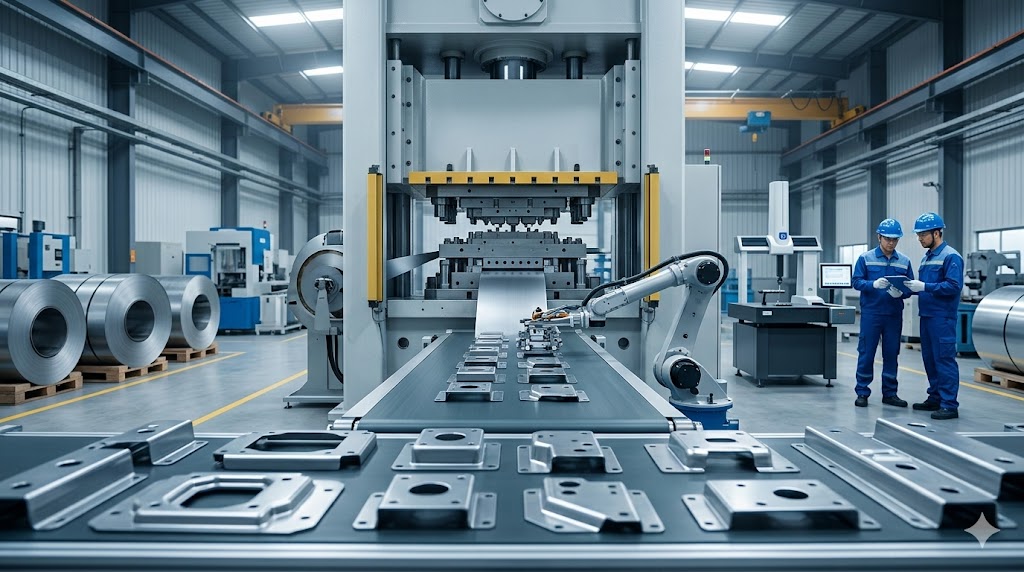
Metal Stamping Vietnam has become a strategic manufacturing solution for global OEMs and industrial buyers seeking precision, scalability, and cost efficiency. As supply chains continue to diversify across Asia, Vietnam stands out for its engineering depth, competitive production environment, and export-ready manufacturing infrastructure.
This service page outlines the core capabilities, quality systems, production scalability, and strategic advantages of Metal Stamping Vietnam for international B2B customers.
Why Metal Stamping Vietnam Is a Strategic Sourcing Choice
Metal Stamping Vietnam combines cost competitiveness with improving engineering capability. While labor advantages remain relevant, the true differentiator lies in technical know-how and process stability.
Manufacturers across Vietnam operate mechanical and hydraulic presses ranging from small tonnage units to large industrial stamping lines. These facilities support both short production runs and high-volume stamping programs.
In addition, growing investment in automation, servo press systems, and die engineering enhances production consistency. As a result, international buyers gain access to stable output, predictable quality, and scalable manufacturing capacity.
Furthermore, Vietnam’s export infrastructure supports efficient shipment to North America, Europe, and other Asia-Pacific markets. This logistical strength reinforces Vietnam’s position as a long-term manufacturing partner.
Core Capabilities in Metal Stamping Vietnam
Metal stamping operations in Vietnam cover a broad spectrum of industrial applications. These include automotive brackets, structural reinforcements, mounting plates, electrical housings, and industrial support components.
Production capabilities typically include:
Progressive die stamping
Transfer die stamping
Single-hit stamping
Deep drawing and secondary forming
Piercing, tapping, and trimming operations
Material processing commonly includes carbon steel, stainless steel, aluminum alloys, and galvanized steel. Thickness ranges vary according to industry requirements, but most facilities can support both light-gauge and medium-gauge sheet metal components.
Moreover, many suppliers integrate secondary processes such as welding, powder coating, and plating. This integration reduces handling time and simplifies project coordination for international buyers.
Engineering and Tooling Expertise
Successful Metal Stamping Vietnam projects rely heavily on tooling accuracy and die design quality.
Tooling departments use CAD/CAM software for strip layout optimization and die design simulation. These tools improve material utilization and reduce scrap rates. At the same time, proper simulation minimizes unexpected die wear and production instability.
In-house tool fabrication enhances control over production timelines. Maintenance teams conduct regular die inspection, alignment checks, and preventive servicing. Consequently, part consistency remains stable across long production cycles.
Engineering collaboration also plays a critical role. Many Vietnamese stamping suppliers provide design-for-manufacturing consultation to help clients optimize geometry, reduce material waste, and improve production feasibility.
Quality Control and Compliance Standards
Quality assurance remains central to Metal Stamping Vietnam operations.
Factories serving export markets typically maintain ISO 9001 certification. Automotive-focused suppliers often comply with IATF 16949 standards. These systems establish structured documentation, inspection protocols, and traceability controls.
Incoming material inspections verify grade and thickness accuracy. During production, operators monitor critical dimensions using digital measurement tools and coordinate measuring machines. Statistical process control methods detect variations early.
Final inspection ensures dimensional accuracy, hole alignment, surface finish quality, and flatness compliance. This multi-stage inspection approach reduces defect rates and strengthens reliability.
Production Scalability and High-Volume Performance
High-volume stamping capability distinguishes leading suppliers in Vietnam.
Automated coil feeding systems and high-speed presses enable efficient production of large batch orders. However, productivity does not compromise precision. Instead, process monitoring systems maintain consistent output quality even under continuous operation.
Lean manufacturing principles also support efficiency. Optimized workflow layouts reduce material handling time. Scrap reduction initiatives improve cost control and environmental performance.
Therefore, global buyers benefit from a balanced combination of cost competitiveness and technical reliability.
Industry Applications for Sheet Metal Parts
Sheet metal parts produced through stamping operations serve diverse industries.
Automotive manufacturers rely on structural brackets, reinforcement panels, and assembly supports. Electronics companies require precise metal housings and shielding components. Industrial machinery producers depend on stamped frames and mounting plates.
Construction and infrastructure sectors also utilize formed steel connectors and structural elements. Because of this wide applicability, Metal Stamping Vietnam supports both specialized and mass-market industrial programs.
Competitive Advantages of Metal Stamping Vietnam
Several structural advantages strengthen Vietnam’s position in global stamping supply chains.
Labor costs remain competitive compared to more mature manufacturing economies. Additionally, industrial parks provide organized infrastructure and tax incentives that encourage long-term investment.
Supply chain integration continues to improve. Local suppliers now provide raw materials, secondary processes, and packaging solutions. Although certain specialty materials may still require import, overall localization reduces lead times and logistics complexity.
Moreover, Vietnam’s participation in trade agreements enhances tariff advantages for key export markets. This benefit improves total landed cost competitiveness for international buyers.
Internal Capability Links
To understand the broader context of stamping services, explore the following related capabilities.
Metal Forming Vietnam provides a comprehensive overview of stamping, deep drawing, and roll forming solutions within the 2026 manufacturing landscape.
Progressive Die Vietnam focuses on high-speed production programs that support complex geometries and continuous strip feeding operations.
Precision Stamping Vietnam delivers tight tolerance components for applications requiring strict dimensional control and high repeatability.
Stamping Tooling Vietnam covers custom die design and fabrication services that ensure long-term production stability and engineering flexibility.
Supplier Evaluation Criteria
Choosing the right Metal Stamping Vietnam partner requires structured analysis.
Buyers should evaluate press capacity range, tooling expertise, engineering support, and quality management systems. Additionally, export experience and communication responsiveness influence project success.
On-site audits provide insight into equipment maintenance, workforce skill level, and production workflow organization. Reviewing capability studies and inspection reports further validates supplier competence.
Effective collaboration during the new product introduction phase reduces risk and shortens ramp-up timelines.
Sustainability and Future Outlook
Sustainability considerations increasingly influence global procurement decisions.
Many Vietnamese stamping factories are improving energy efficiency and implementing waste reduction programs. Responsible material sourcing and environmental compliance measures strengthen long-term viability.
Automation trends will continue to reshape Metal Stamping Vietnam operations. Robotic part handling, real-time monitoring, and digital production tracking enhance efficiency and transparency.
As global OEMs prioritize supply chain diversification, Vietnam’s stamping industry is positioned for continued expansion.
Conclusion
Metal Stamping Vietnam offers precision engineering solutions, scalable high-volume stamping capacity, and export-ready manufacturing infrastructure. By combining technical expertise, quality management systems, and competitive cost structures, Vietnamese suppliers provide reliable support for global B2B production programs.
Companies seeking dependable sheet metal parts and long-term manufacturing partnerships can leverage Vietnam’s evolving industrial ecosystem to achieve operational efficiency and risk diversification.