
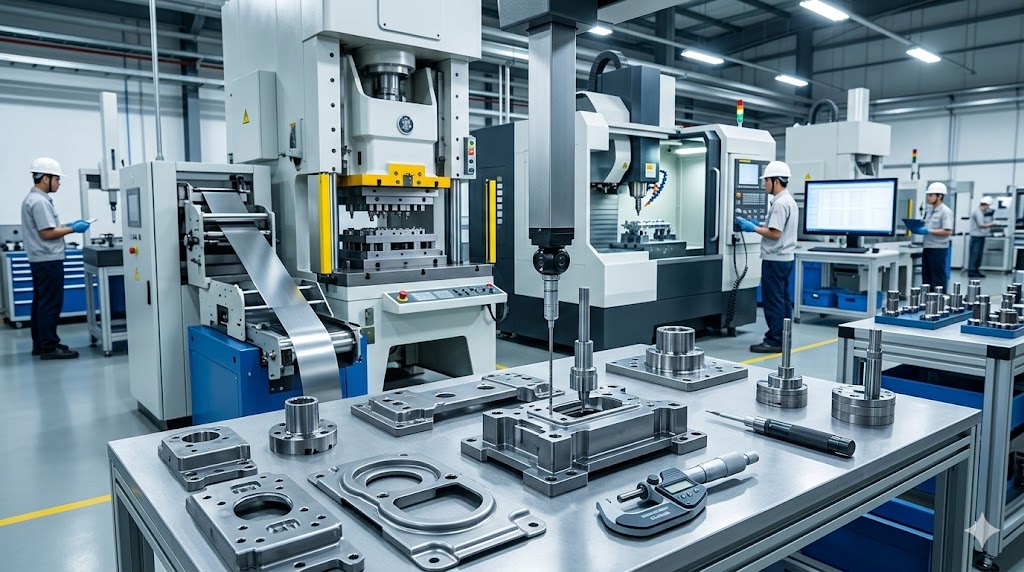
Precision Stamping Vietnam has become a strategic solution for global OEMs that require tight tolerance components, consistent quality, and cost-efficient production. As industries demand higher dimensional stability and repeatability, manufacturers in Vietnam are investing in advanced tooling, automation, and process control systems to meet strict engineering standards.
Today, buyers in automotive, electronics, industrial equipment, and renewable energy sectors increasingly rely on Precision Stamping Vietnam to deliver high-performance metal parts that meet international specifications. Moreover, Vietnam’s strong manufacturing ecosystem allows companies to combine engineering expertise with competitive production costs, making it an attractive sourcing destination.
Why Choose Precision Stamping Vietnam for Tight Tolerance Parts
Precision stamping involves forming metal sheets into complex geometries using custom dies and high-tonnage presses. However, when tight tolerances are required, the process must be supported by strict quality control, advanced tooling design, and stable production conditions.
In Precision Stamping Vietnam operations, manufacturers typically apply:
- High-speed mechanical or servo presses
- Progressive die systems
- In-die inspection technologies
- Statistical process control
- Automated feeding and material handling
As a result, dimensional consistency is maintained across high-volume production runs. In addition, Vietnamese suppliers serving export markets comply with ISO 9001 and, in many cases, IATF 16949 for automotive applications.
Global buyers benefit from reduced scrap rates, stable cycle times, and predictable lead times. Therefore, Precision Stamping Vietnam is not merely about low-cost production; it is about engineering-driven manufacturing with measurable performance outcomes.
Engineering Capabilities Behind Precision Stamping Vietnam
Achieving tight tolerances requires more than press capacity. It requires engineering discipline across the entire value chain.
Tooling Design and Die Manufacturing
Tooling is the foundation of precision stamping. Vietnamese manufacturers increasingly operate in-house tool rooms equipped with CNC machining centers, EDM systems, and surface grinders. Consequently, die design can be optimized for material flow, springback compensation, and burr control.
Advanced CAD/CAM software allows engineers to simulate forming processes before actual production begins. This approach reduces trial-and-error cycles and shortens time-to-market.
Material Selection and Control
Precision Stamping Vietnam projects typically involve materials such as:
- Cold-rolled steel
- Stainless steel
- Aluminum alloys
- Copper and brass
- High-strength low-alloy steels
Each material behaves differently under forming stress. Therefore, suppliers carefully analyze tensile strength, elongation, and thickness variation. Material traceability systems are implemented to ensure compliance with customer specifications.
Process Stability and Repeatability
To maintain tight tolerances, manufacturers monitor press force, stroke consistency, and die alignment. Moreover, inline inspection systems detect dimensional deviations early in the process. By applying statistical analysis, suppliers can maintain consistent Cp and Cpk values across large production volumes.
Micron-Level Performance in Precision Stamping Vietnam
Micron-level performance is often required in electronics connectors, sensor housings, and precision brackets. In such cases, even minimal dimensional variation can lead to assembly issues or product failure.
Micron-level accuracy
Micron-level accuracy is achievable through optimized die clearance, precision-ground punches, and temperature-controlled environments. Vietnamese manufacturers serving export clients increasingly adopt coordinate measuring machines and optical inspection systems to verify micro-tolerances.
Furthermore, automated inspection ensures that deviations are identified immediately rather than after batch completion. This proactive approach significantly reduces rework costs and improves overall equipment effectiveness.
Advanced Production Through CNC Metal Stamping
While conventional stamping remains effective for many applications, certain complex geometries require additional machining precision.
CNC metal stamping
CNC metal stamping integrates programmable control with traditional stamping operations. It allows for precise control of feed length, stroke depth, and forming speed. As a result, parts with intricate cutouts, embossing, and secondary operations can be produced with exceptional consistency.
In Precision Stamping Vietnam facilities, CNC integration often works alongside robotic handling systems. This combination enhances productivity while maintaining strict tolerance control. Additionally, CNC-assisted die adjustments help reduce setup time during product changeovers.
Applications of Precision Stamping Vietnam Across Industries
Precision stamping components are widely used in industries that demand both structural integrity and dimensional accuracy.
Automotive Industry
Automotive OEMs require brackets, clips, battery connectors, and structural reinforcements. Because safety and reliability are critical, tolerances must be tightly controlled. Precision Stamping Vietnam suppliers serving this sector implement IATF-compliant systems and maintain detailed documentation.
Electronics and Electrical Equipment
Electronics manufacturers depend on stamped terminals, shielding components, and precision housings. In this context, surface finish and micro-tolerance control are essential. Therefore, many Vietnamese factories incorporate clean production zones and advanced inspection tools.
Industrial Machinery
Industrial equipment requires durable stamped components capable of withstanding mechanical stress. By combining progressive dies with secondary operations such as tapping or welding, Precision Stamping Vietnam providers deliver integrated solutions.
Renewable Energy and EV Systems
As electric vehicles and renewable energy systems expand, demand for precision metal parts grows. Battery components, inverter housings, and mounting structures require high dimensional stability. Vietnamese stamping facilities are increasingly adapting to these high-growth markets.
Quality Control Framework in Precision Stamping Vietnam
Quality assurance is central to competitive manufacturing. Without strict control systems, tight tolerance production is not sustainable.
Incoming Material Inspection
Suppliers verify thickness, mechanical properties, and surface condition before production begins. This step prevents downstream defects and ensures compliance with engineering drawings.
In-Process Monitoring
Operators conduct dimensional checks at defined intervals. Additionally, automated sensors monitor press performance in real time. When deviations occur, corrective action is implemented immediately.
Final Inspection and Documentation
Before shipment, parts undergo final inspection using calibrated measuring instruments. Reports such as PPAP, First Article Inspection, and material certificates are provided upon request. This transparency builds trust with international buyers.
Cost Efficiency Without Compromising Precision
One of the main advantages of Precision Stamping Vietnam is cost competitiveness. Labor costs remain lower than in many developed countries. However, cost advantage alone does not define value.
Vietnam benefits from:
- A growing base of skilled engineers
- Strong supply chain networks for raw materials
- Strategic geographic location in Asia
- Trade agreements such as CPTPP and EVFTA
These factors reduce tariffs and shipping complexity for global customers. Consequently, buyers can achieve both quality and cost optimization.
Integration with Broader Metal Manufacturing Capabilities
Precision stamping rarely operates in isolation. Many projects require complementary processes such as machining, welding, or surface treatment.
Metal Stamping Vietnam
Metal Stamping Vietnam serves as the broader category encompassing high-volume stamping solutions. While Precision Stamping Vietnam focuses on tight tolerance parts, Metal Stamping Vietnam platforms often provide scalable production capacity and integrated engineering support.
By leveraging comprehensive stamping ecosystems, buyers can consolidate suppliers and streamline procurement management.
Selecting the Right Precision Stamping Vietnam Partner
Choosing the right supplier requires a structured evaluation process.
First, assess engineering capability and tooling expertise. Second, verify quality certifications and inspection equipment. Third, review production capacity and lead time stability. Finally, evaluate communication efficiency and project management responsiveness.
It is advisable to request sample parts and conduct technical discussions before mass production approval. Additionally, site audits or third-party inspections can further validate manufacturing capability.
Future Outlook of Precision Stamping Vietnam
Vietnam’s manufacturing sector continues to evolve rapidly. Automation investment, digital quality control, and workforce training are improving industry standards year after year.
As global companies diversify supply chains, Vietnam is positioned as a reliable alternative to traditional sourcing regions. Precision Stamping Vietnam will likely play a crucial role in high-value component manufacturing, especially in automotive electrification, advanced electronics, and industrial automation.
Manufacturers that focus on continuous improvement, lean production, and technology upgrades will gain competitive advantage in international markets.
Conclusion
Precision Stamping Vietnam provides a strategic combination of engineering expertise, micron-level accuracy, and cost efficiency. Through advanced tooling, CNC metal stamping integration, and strict quality control systems, Vietnamese manufacturers can deliver tight tolerance parts that meet global standards.
For OEMs seeking reliable production partners, Vietnam offers not only competitive pricing but also scalable technical capability. If your project requires high-precision stamped components with consistent performance, partnering with an experienced Precision Stamping Vietnam supplier can optimize both quality and long-term supply stability.