
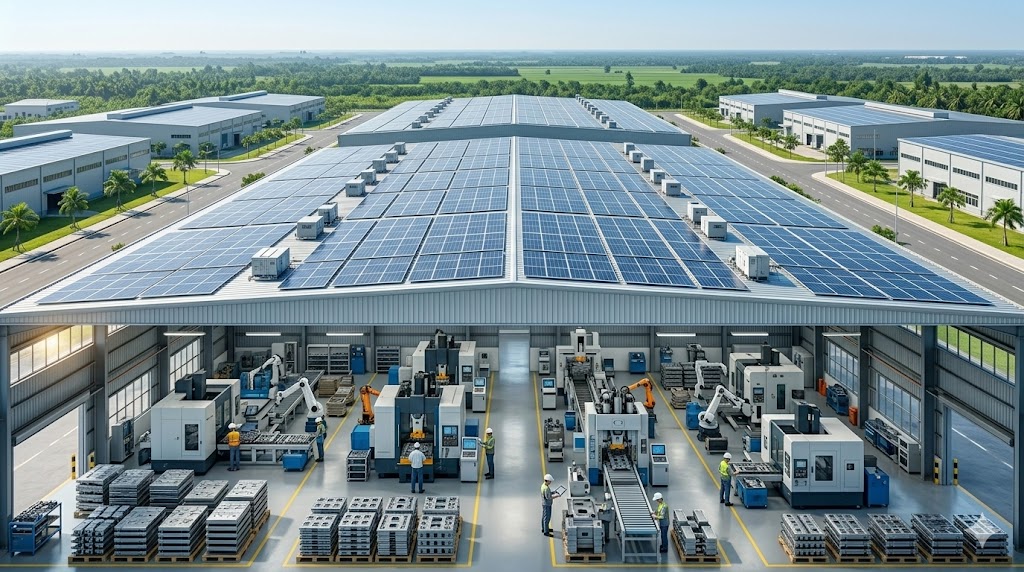
A Solar Powered Factory model is transforming Vietnam’s metal manufacturing landscape by integrating renewable energy systems directly into production facilities. As global B2B buyers demand lower carbon footprints and stronger ESG compliance, Vietnam has responded with scalable, cost-effective solutions that combine solar infrastructure with advanced metal forming technologies. This case study explores how the Solar Powered Factory approach supports renewable energy adoption and accelerates green manufacturing in the industrial sector.
The Strategic Shift Toward Solar Powered Factory Operations
Vietnam’s manufacturing industry has expanded rapidly over the past decade. However, rising energy consumption and international sustainability requirements have forced producers to rethink traditional power sourcing models. Instead of relying solely on grid electricity, leading metal factories now deploy rooftop photovoltaic systems, ground-mounted solar farms, and hybrid energy storage solutions.
A Solar Powered Factory reduces dependence on fossil fuels while stabilizing long-term operational costs. Because solar irradiation levels in southern and central Vietnam are highly favorable, factories can generate a significant portion of their daily electricity on-site. Consequently, manufacturers improve energy resilience while mitigating exposure to volatile power pricing.
Furthermore, many industrial parks now support renewable infrastructure investments. As a result, solar integration is no longer limited to pilot projects. It has become a mainstream strategy for forward-looking manufacturers serving the US, EU, and other ESG-focused markets.
Renewable Energy Integration in Metal Manufacturing
Metal forming processes such as stamping, machining, die casting, and fabrication are energy intensive. Press machines, CNC equipment, furnaces, and surface treatment lines require stable power supply. Therefore, integrating renewable energy into such environments demands careful planning.
A Solar Powered Factory typically combines the following elements:
Rooftop photovoltaic panels installed across large industrial roofs
Inverters and smart energy management systems
Battery storage for peak shaving and load balancing
Grid synchronization to maintain uninterrupted production
Through intelligent load distribution, factories prioritize solar-generated electricity during peak daylight hours. Meanwhile, stored energy supports nighttime operations or compensates for cloud cover. This system design ensures production continuity while maximizing renewable utilization.
Importantly, renewable energy adoption aligns with carbon reduction commitments under global frameworks. Many international buyers now require emissions data transparency. By operating a Solar Powered Factory, Vietnamese manufacturers can provide verifiable energy sourcing records, which strengthens supplier credibility.
Solar Powered Factory and Green Manufacturing Performance
Green manufacturing goes beyond energy sourcing. It encompasses waste reduction, efficient material usage, emissions control, and sustainable supply chain management. Nevertheless, renewable power remains a cornerstone of environmental performance.
In a Solar Powered Factory environment, measurable benefits include:
Lower Scope 2 emissions due to reduced grid electricity consumption
Reduced long-term energy expenditure
Enhanced ESG reporting accuracy
Improved brand positioning for export markets
Additionally, solar-powered facilities often integrate other efficiency upgrades. For example, variable frequency drives optimize motor performance. LED lighting systems reduce auxiliary power consumption. Water recycling systems further decrease environmental impact.
Because of these improvements, green manufacturing is not merely a marketing concept. It becomes a quantifiable operational advantage. Buyers seeking long-term partnerships increasingly prioritize suppliers that demonstrate consistent sustainability metrics.
Case Study: Solar Powered Factory Implementation in Vietnam
Consider a mid-sized metal forming facility located in southern Vietnam serving automotive and industrial equipment customers. Facing rising electricity costs and stricter European ESG requirements, management invested in a 2 MW rooftop solar system.
During the first year of operation, the factory achieved the following results:
Approximately 35 to 45 percent of daytime electricity supplied by solar
Annual reduction of several thousand tons of CO₂ emissions
Stabilized energy costs despite national tariff adjustments
Improved ESG audit outcomes for EU clients
Moreover, the company implemented energy monitoring software that provides real-time data on power generation and consumption. This transparency allowed clients to validate sustainability claims during supplier evaluations.
Over time, the Solar Powered Factory model strengthened the facility’s competitive positioning. Instead of competing solely on labor cost, the manufacturer differentiated itself through environmental responsibility and long-term risk mitigation.
Economic Viability of Solar Powered Factory Models
While sustainability drives strategic motivation, financial feasibility remains critical. Fortunately, solar technology costs have declined significantly over the past decade. Module efficiency has improved, installation processes have matured, and financing mechanisms have become more accessible.
Payback periods for industrial solar installations in Vietnam typically range between four and seven years, depending on system size and electricity pricing structures. Because metal factories operate high-load machinery during daylight hours, self-consumption rates are generally strong. As a result, return on investment is often attractive.
In addition, government policies have periodically supported renewable development through feed-in tariffs or regulatory incentives. Although policy frameworks evolve, the long-term direction favors clean energy integration.
Therefore, a Solar Powered Factory does not represent an environmental expense. Instead, it functions as a strategic capital investment that enhances cost predictability and ESG alignment.
ESG Compliance and Global Market Access
International buyers increasingly incorporate ESG criteria into supplier selection processes. This trend is particularly strong in Europe and North America. Companies exporting metal components must now provide documentation related to energy sourcing, carbon intensity, and environmental management systems.
Operating a Solar Powered Factory directly supports these requirements. Manufacturers can integrate solar data into sustainability reports, life cycle assessments, and carbon footprint calculations. Consequently, suppliers gain stronger positioning during procurement negotiations.
In addition, multinational corporations often require adherence to science-based emission targets. Vietnamese factories powered partially by renewable energy are better equipped to meet such expectations. This alignment reduces the risk of future compliance disruptions.
Solar Powered Factory and Long-Term Industrial Strategy
Vietnam aims to strengthen its reputation as a high-quality manufacturing hub. Cost competitiveness alone is no longer sufficient. Buyers expect technological capability, stable supply chains, and responsible production standards.
A Solar Powered Factory represents a visible and measurable commitment to industrial modernization. By integrating renewable energy into heavy manufacturing environments, Vietnam demonstrates readiness for next-generation supply chain demands.
Moreover, sustainable infrastructure enhances investor confidence. Financial institutions increasingly evaluate environmental performance before extending credit or partnership agreements. Therefore, factories that embrace solar energy often improve access to financing.
Over the next decade, renewable integration will likely expand across additional industrial sectors. Metal forming, machining, and fabrication will continue leading this transition due to their high energy intensity and export exposure.
Positioning Within Sustainable Metal Forming
The Solar Powered Factory concept forms a critical component of broader sustainable strategies.
For a deeper strategic overview, explore Sustainable Manufacturing: ESG Metal Forming 2026. This pillar discusses how environmental governance, energy efficiency, and responsible sourcing reshape Vietnam’s metal industry roadmap toward 2026 and beyond.
Within that framework, renewable infrastructure becomes a foundational element rather than a supplementary feature. Solar integration supports measurable ESG metrics and reinforces long-term resilience.
Renewable Energy and Industrial Decarbonization
Industrial decarbonization requires systemic change.
Learn more about Renewable energy solutions that power Vietnam’s transition toward lower-emission manufacturing environments. This resource explains how solar, wind, and hybrid systems integrate into heavy industry applications.
As energy markets evolve, renewable adoption strengthens both environmental compliance and operational independence.
Advancing Green Manufacturing in Vietnam
Sustainability must extend beyond energy generation.
Explore Green manufacturing strategies that complement Solar Powered Factory investments. From waste minimization to closed-loop material systems, comprehensive environmental programs enhance overall industrial performance.
By combining renewable power with process optimization, manufacturers create durable competitive advantages in global markets.
Conclusion: Solar Powered Factory as a Competitive Differentiator
A Solar Powered Factory in Vietnam is more than a technological upgrade. It is a strategic response to global ESG expectations, rising energy costs, and long-term supply chain transformation. Through renewable energy integration, metal manufacturers strengthen resilience, improve environmental performance, and secure access to demanding international markets.
As sustainability becomes a decisive procurement criterion, factories that adopt solar infrastructure position themselves ahead of regulatory and market shifts. Vietnam’s industrial sector has already demonstrated that renewable energy and heavy manufacturing can coexist effectively.
For B2B buyers seeking reliable partners in metal forming, sourcing from a Solar Powered Factory offers measurable environmental value alongside cost efficiency and production expertise. The future of manufacturing will reward those who align innovation with responsibility, and Vietnam’s solar-powered metal factories are leading that transition.