
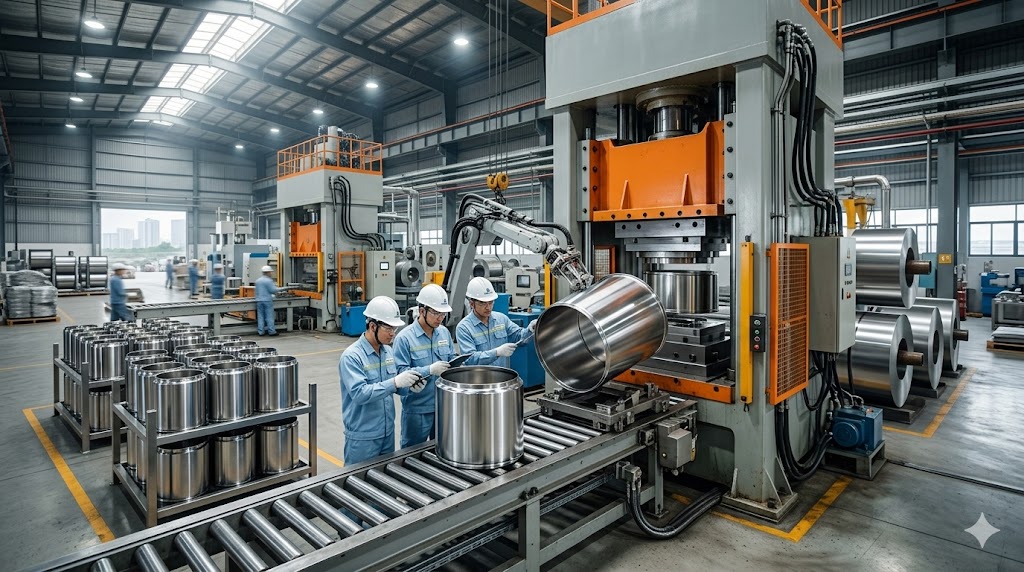
Stainless Steel Forming in Vietnam has become a reliable solution for OEMs requiring high-strength, corrosion-resistant, and export-grade deep drawn components. As industries demand durable materials capable of operating in harsh environments, stainless steel deep drawing continues to gain strategic importance.
Vietnamese manufacturers combine advanced press systems, precision tooling, and strict quality control to deliver stainless steel components that meet international standards. Moreover, integrated production workflows allow forming, trimming, surface finishing, and inspection to be managed under one coordinated system. Consequently, global buyers benefit from stable lead times and consistent dimensional performance.
Why Stainless Steel Forming Is Critical for Industrial Applications
Stainless steel offers exceptional mechanical strength and natural corrosion resistance. Therefore, it is widely used in medical equipment, food processing systems, marine components, energy infrastructure, and industrial machinery.
Unlike mild steel, stainless steel exhibits higher work hardening rates. As a result, deep drawing requires controlled force distribution and precise lubrication strategies. Manufacturers engaged in Stainless Steel Forming must carefully optimize draw ratios to avoid tearing or excessive thinning.
In addition, export-focused production requires traceability documentation and dimensional validation. Vietnamese suppliers serving global markets increasingly meet these requirements through ISO-certified systems and structured inspection protocols.
Technical Capabilities in Stainless Steel Forming
Successful stainless steel deep drawing depends on engineering expertise and process control. Multiple variables influence final part quality.
Material Grade Selection and Preparation
Different stainless steel grades, such as 304 or 316, provide varying levels of strength and corrosion resistance. Consequently, material selection must align with environmental exposure and structural demands.
Before forming begins, sheets are inspected for thickness consistency and surface quality. Proper blank sizing reduces wrinkling risk during the drawing stage.
Tooling Precision and Simulation
Tool design directly affects dimensional accuracy. Engineers use CAD/CAM systems to simulate material flow and identify potential stress concentration points. This proactive analysis reduces development cycles and enhances repeatability.
Precision-ground punches and die sets ensure stable geometry throughout production. Furthermore, lubrication strategies are optimized to manage friction and prevent surface defects.
Press Technology and Controlled Deformation
Hydraulic presses allow adjustable forming pressure, which is essential for high-strength materials. Meanwhile, mechanical presses can support faster cycles when geometry permits.
Process monitoring systems track stroke depth and forming force. Therefore, deviations are identified quickly, which prevents cumulative dimensional drift.
Performance Advantages of Stainless Steel Forming
Stainless steel deep drawing offers several performance benefits compared to welded assemblies.
Corrosion resistance
Corrosion resistance is a primary advantage of stainless steel components. In aggressive environments such as marine or chemical processing systems, seamless deep drawn parts provide long-term durability.
Additionally, uniform wall thickness reduces stress concentration points, which further enhances structural reliability.
Applications in Industrial Housings and Structural Enclosures
Deep drawn stainless steel components are widely used for protective housings and structural casings.
Industrial housings
Industrial housings manufactured through Stainless Steel Forming provide seamless construction and improved strength under pressure or vibration. Because the forming process eliminates weld seams, both structural integrity and appearance improve.
Integrated trimming and finishing operations deliver ready-to-install enclosure solutions for pumps, sensors, filtration systems, and energy equipment.
Integration with Advanced Deep Drawing Expertise
Stainless steel deep drawing operates within a broader technical ecosystem.
Deep Drawing Vietnam
Deep Drawing Vietnam represents the specialized forming capability that supports cylindrical and enclosure-type components across multiple materials. Stainless Steel Forming is a focused segment within this broader manufacturing framework.
By leveraging Deep Drawing Vietnam expertise, OEMs gain access to advanced simulation-driven tooling, precise press control, and structured quality management systems.
Quality Assurance and Export Compliance
Export-quality production requires rigorous inspection at every stage.
In-Process Monitoring
Operators conduct dimensional checks at defined production intervals. Meanwhile, automated sensors monitor forming pressure and stroke consistency.
If any deviation occurs, corrective measures are implemented immediately. Consequently, batch-to-batch variation remains minimal.
Final Inspection and Documentation
Before shipment, components undergo final dimensional verification and visual surface inspection. When required, suppliers provide material certificates, inspection reports, and compliance documentation to support international trade requirements.
These quality systems strengthen long-term partnerships with global OEM clients.
Commercial and Supply Chain Advantages
Vietnam offers competitive cost structures combined with growing technical capability. However, cost efficiency alone does not define value. Stable engineering support and predictable delivery schedules are equally important.
Trade agreements such as CPTPP and EVFTA enhance export competitiveness. Furthermore, expanding industrial clusters enable better integration between forming, machining, and finishing processes.
Because suppliers can adapt tooling and process parameters quickly, production continuity is maintained even when design modifications arise.
Future Outlook of Stainless Steel Forming in Vietnam
Demand for corrosion-resistant and high-strength components continues to increase across industrial sectors. Electrification, renewable energy, and medical equipment manufacturing are driving this trend.
Vietnam’s investment in automation, digital inspection systems, and engineering training strengthens its position as a technically capable forming hub. As a result, Stainless Steel Forming is evolving from a cost-driven alternative into a mature export-grade manufacturing solution.
Conclusion
Stainless Steel Forming in Vietnam delivers high-strength, corrosion-resistant deep drawn components designed for demanding industrial environments. Through advanced tooling, controlled press technology, and structured quality assurance systems, Vietnamese manufacturers support global OEM production requirements.
For companies seeking export-quality stainless steel deep drawing with consistent performance and commercial competitiveness, Vietnam provides a reliable and scalable manufacturing partner.