
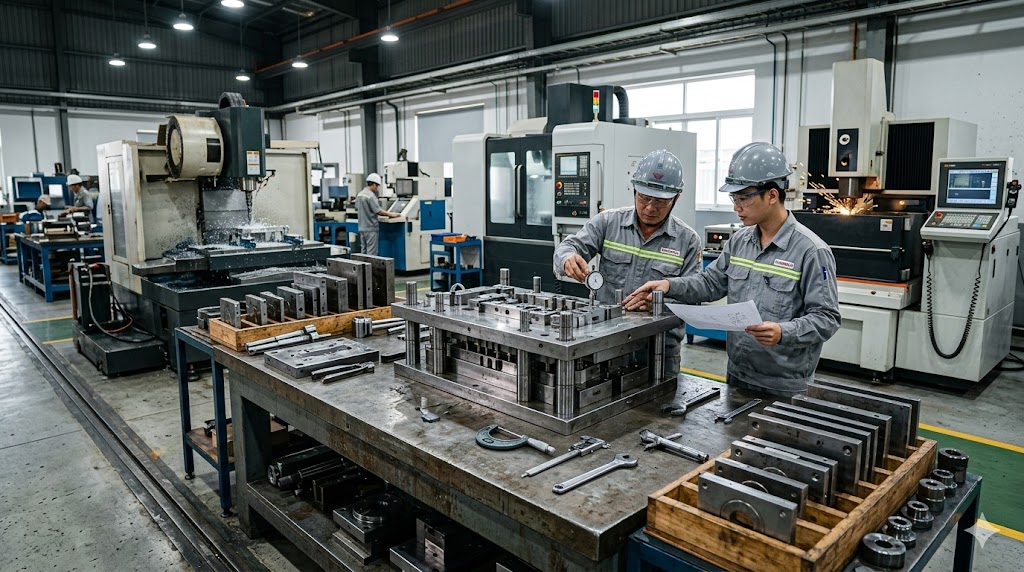
Stamping Tooling Vietnam is a decisive factor in achieving stable, high-quality metal stamping production for global OEMs. In modern manufacturing, tooling is not merely a supporting element. Instead, it defines dimensional precision, repeatability, production efficiency, and long-term cost control.
As supply chains continue to diversify, Vietnam has strengthened its tooling capabilities to meet international engineering standards. Today, buyers evaluating stamping suppliers increasingly assess tooling expertise before approving production contracts.
Why Stamping Tooling Vietnam Matters in Metal Stamping Projects
In stamping operations, tooling determines how raw material transforms into finished components. Without properly engineered dies, even advanced press systems cannot maintain consistent tolerances.
Tooling impacts:
- Part geometry and dimensional accuracy
- Surface finish quality
- Production speed and cycle stability
- Scrap rate and material efficiency
- Overall lifecycle cost
Therefore, manufacturers investing in strong tooling infrastructure gain a competitive advantage. Vietnam’s expanding industrial base now includes modern tool rooms equipped with CNC machining centers, EDM systems, precision grinding equipment, and CAD/CAM engineering platforms.
This evolution enables suppliers to support automotive, electronics, industrial equipment, and renewable energy applications.
Engineering Workflow in Stamping Tooling Vietnam
A structured engineering process ensures predictable outcomes and minimizes development risk.
Concept Development and Design Validation
Tooling projects begin with 3D modeling and simulation. Engineers analyze material flow, springback behavior, and stress distribution before fabrication starts. This early validation reduces trial-and-error during tool tryout.
Moreover, optimized strip layouts improve material utilization and reduce waste. Consequently, customers benefit from better cost efficiency and shorter lead times.
Precision Tool Fabrication
Once the design is finalized, fabrication begins in controlled environments. CNC milling, wire EDM, and surface grinding ensure dimensional precision of punches, die plates, and guiding elements.
Assembly accuracy is equally critical. During this phase, alignment tolerances are carefully verified. Proper alignment ensures smooth operation within stamping presses and prevents premature wear.
Commercial Impact of Advanced Tooling Capabilities
Tooling represents a significant capital investment. However, its quality directly influences production stability and operational cost.
Professional suppliers provide:
- Transparent tooling quotation structures
- Defined lead times
- Warranty terms
- Ownership clarity
- Engineering change management procedures
Vietnam offers competitive tooling costs compared to many traditional manufacturing hubs. At the same time, technical capability continues to improve, which strengthens commercial viability for international buyers.
Tool Steel Strategy in High-Performance Tooling
Material selection is fundamental to tooling durability and performance.
Tool steel selection
Tool steel selection affects wear resistance, hardness stability, and maintenance frequency. In advanced tooling projects, engineers evaluate forming pressure, material thickness, and expected production volume before choosing appropriate steel grades.
High-volume production often requires hardened tool steels to withstand continuous stress. Meanwhile, moderate-volume programs may allow alternative grades to balance cost and durability. Structured material evaluation ensures predictable tool life and minimized downtime.
Lifecycle Stability Through Preventive Care
Tooling reliability depends on systematic inspection and maintenance.
Die maintenance
Die maintenance ensures long-term dimensional consistency and operational safety. Professional tooling operations establish preventive schedules based on stroke count and wear patterns.
Routine checks include punch sharpening, guide alignment inspection, lubrication monitoring, and replacement of wear components. By implementing predictive maintenance strategies, suppliers reduce unexpected breakdowns and protect production continuity.
Case Study: Tooling Optimization for Industrial Brackets
A European industrial equipment manufacturer required complex stamped brackets with tight dimensional control. Annual volume exceeded 400,000 units, and delivery stability was critical.
Engineering Approach
The supplier designed a progressive die system to integrate multiple forming stages into a single process. Simulation software identified potential deformation risks before fabrication.
Engineers optimized strip layout to improve raw material utilization. In addition, hardened tool steel was selected to extend tool life under repetitive forming stress.
Operational Outcome
After tool validation and fine adjustments, production achieved stable tolerances throughout large-volume runs. Scrap rates declined compared to previous sourcing arrangements.
Preventive maintenance intervals were defined early, which reduced unplanned downtime. As a result, the client experienced improved cost predictability and supply chain reliability.
This example illustrates how structured tooling development supports commercial success.
Integration with Broader Stamping Capabilities
Tooling services operate most effectively when integrated with full stamping production.
Metal Stamping Vietnam refers to comprehensive stamping production supported by engineering, tooling, and quality control systems. While tooling focuses on die development and fabrication, integration with Metal Stamping Vietnam operations ensures seamless transition from tool tryout to mass production.
This unified approach reduces communication gaps, accelerates project launch, and enhances accountability throughout the production lifecycle.
Quality Control in Tooling Development
Quality validation begins during the initial tool tryout stage.
Trial Production and Dimensional Verification
Engineers produce sample parts and measure them against technical drawings. Deviations are corrected through fine adjustments in die alignment or component modification.
Once dimensional stability is confirmed, documentation supports customer approval procedures.
Continuous Improvement
Even after production begins, tooling performance is continuously monitored. Production data provides insights into wear behavior and potential optimization opportunities.
This proactive management ensures sustained reliability over extended production cycles.
Strategic Advantages of Vietnam in Tooling Development
Several structural factors strengthen Vietnam’s position:
- Expanding engineering talent pool
- Investment in modern manufacturing equipment
- Competitive labor structure
- Trade agreements supporting global exports
- Growing ecosystem of supporting industries
As global companies reduce supply chain concentration risks, Vietnam has become a practical and technically capable alternative.
Future Outlook
Digitalization and automation are transforming tooling operations. Simulation accuracy continues to improve, and predictive maintenance technologies are gaining adoption.
Furthermore, industries such as electric vehicles and advanced electronics demand increasingly complex stamped components. Suppliers that invest in engineering expertise and precision tooling infrastructure will lead this transformation.
Conclusion
Stamping Tooling Vietnam delivers the engineering foundation required for stable, cost-effective metal stamping production. Through structured design validation, precision fabrication, strategic tool steel selection, and disciplined die maintenance, Vietnamese manufacturers support global OEM requirements with confidence.
For buyers evaluating sourcing strategies, selecting a partner with strong tooling capability ensures long-term performance, predictable cost, and consistent production quality.