
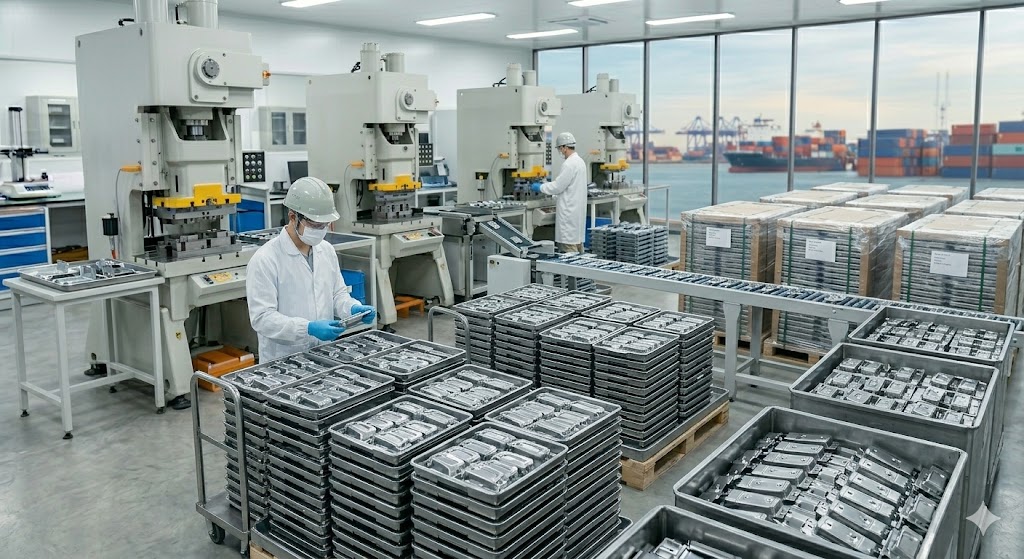
Stamping Volume Pricing plays a decisive role in determining total unit cost for high-volume metal components. For manufacturers sourcing from Vietnam, understanding how volume discount structures work is essential to securing competitive bulk order rates while ensuring scalable production capacity.
In 2026, global procurement teams increasingly focus on cost predictability, long-term agreements, and supply stability. Therefore, Stamping Volume Pricing must be evaluated within a broader framework of tooling amortization, material planning, and production efficiency. Vietnam’s growing industrial ecosystem supports flexible pricing tiers designed to reward stable demand and forecast accuracy.
How Stamping Volume Pricing Works in Vietnam
Stamping Volume Pricing is structured around economies of scale. As production volume increases, fixed costs distribute more efficiently across output. These fixed costs typically include tooling amortization, machine setup time, and engineering overhead.
Vietnamese stamping facilities generally apply tiered pricing models such as:
Low-volume prototype pricing
Mid-volume pilot production pricing
High-volume mass production pricing
Because machine changeover and die setup represent non-negligible expenses, higher volumes reduce per-unit overhead impact. Consequently, buyers who commit to long-term programs benefit from lower average cost.
Moreover, accurate demand forecasting allows suppliers to optimize production scheduling. Improved efficiency then translates directly into more competitive pricing.
Bulk Order Rates and Cost Efficiency
Competitive Bulk order rates depend on annual volume commitments and consistent purchasing schedules. Suppliers in Vietnam often offer pricing incentives when buyers provide rolling forecasts or multi-year agreements.
Bulk pricing advantages typically include:
Reduced per-unit stamping cost
Priority production scheduling
Lower scrap ratio due to stable runs
Improved logistics planning
However, procurement teams must balance discount opportunities with inventory carrying cost. Ordering excessive volume may reduce unit price but increase warehousing expenses.
Strategic planning ensures that volume commitments align with real market demand.
Scalable Production and Capacity Planning
Vietnam’s stamping sector has expanded significantly in recent years. Modern facilities operate high-tonnage presses, progressive dies, and automated feeding systems capable of supporting scalable production.
Effective Scalable production allows manufacturers to increase output without sacrificing quality or delivery timelines. Capacity planning includes:
Press tonnage allocation
Tool maintenance scheduling
Material supply coordination
Labor shift optimization
When suppliers demonstrate true scalability, buyers gain confidence in long-term production continuity. This reliability strengthens negotiation leverage in volume pricing discussions.
Furthermore, scalable production reduces risk of bottlenecks during peak demand periods.
Volume Tier Structures Explained
Stamping Volume Pricing typically follows structured volume tiers. While exact thresholds vary by supplier and component complexity, a simplified model might include:
Tier 1: 1,000 to 10,000 units
Tier 2: 10,000 to 100,000 units
Tier 3: 100,000+ units
At each tier, per-unit cost decreases as fixed cost allocation spreads across larger output.
However, tier transitions must consider tooling durability and press capacity. Rapid volume increases without proper planning may strain equipment or supply chain resources.
Therefore, open communication between buyer and supplier remains critical.
Tooling Amortization and Volume Alignment
Tooling cost significantly influences Stamping Volume Pricing. When production volume is low, tooling amortization heavily impacts unit price. Conversely, high-volume production minimizes tooling cost per piece.
Buyers should negotiate clear amortization structures, including:
Tool ownership agreements
Amortization schedule
Maintenance responsibility
Tool life projections
Aligning tooling strategy with volume forecasts improves Manufacturing ROI and stabilizes pricing.
To understand how tooling affects total forming economics, review our detailed analysis of Metal Forming Cost in Vietnam.
Long-Term Agreements and Pricing Stability
Long-term supply agreements enhance pricing predictability. Suppliers can allocate machine capacity and material procurement more efficiently when demand visibility extends beyond short-term purchase orders.
Advantages of structured agreements include:
Locked-in pricing tiers
Reduced exposure to material volatility
Improved production planning
Stronger supplier partnership
Nevertheless, contracts must incorporate flexibility clauses to address demand fluctuations. Balanced agreements protect both buyer and supplier interests.
Production Efficiency and Scrap Reduction
Higher production volume improves process optimization. As stamping runs stabilize, scrap rates typically decrease due to refined die alignment and improved operator familiarity.
Lower scrap contributes directly to reduced Stamping Volume Pricing. Material efficiency enhances profitability for both parties.
Moreover, continuous improvement programs implemented in many Vietnamese factories support incremental cost reduction over time.
Risk Management in Volume Commitments
While higher volumes unlock pricing benefits, they also introduce financial and operational risk. Overcommitting to volume without confirmed demand can create excess inventory or unused capacity.
Therefore, procurement teams should conduct structured demand analysis before entering high-volume contracts.
Supplier due diligence is equally important. Evaluate:
Press capacity availability
Quality control systems
Financial stability
Export experience
Vietnam’s stamping industry continues to mature, yet structured evaluation remains essential.
Negotiation Strategies for Stamping Volume Pricing
Effective negotiation requires transparency. Buyers should request detailed cost breakdowns that clarify:
Material percentage of cost
Labor allocation
Machine time cost
Tooling amortization
Understanding cost drivers allows informed negotiation rather than arbitrary price reduction requests.
In addition, multi-product bundling may strengthen bargaining power. Combining multiple components under a single supplier contract often enhances discount potential.
Integration Within Broader Sourcing Strategy
Stamping Volume Pricing decisions must align with overall sourcing objectives. Volume planning intersects with tariff management, logistics optimization, and supplier diversification.
When integrated within a broader sourcing framework, volume strategy strengthens cost resilience and operational flexibility.
Vietnam’s expanding industrial parks and export infrastructure support long-term scalable partnerships.
2026 Outlook for Volume-Based Pricing
As automation continues to expand in Vietnam’s metal forming sector, per-unit labor influence will decline gradually. Consequently, machine utilization and energy efficiency will become more significant cost drivers.
Buyers should monitor:
Wage growth trends
Material price volatility
Energy cost shifts
Capacity expansion investments
Although pricing may fluctuate, strategic volume planning will remain a primary lever for cost optimization.
Conclusion: Maximizing Value Through Stamping Volume Pricing
Stamping Volume Pricing in Vietnam offers significant cost advantages when structured correctly. By leveraging bulk order rates and scalable production capacity, manufacturers can reduce per-unit cost while maintaining quality and delivery performance.
However, successful volume strategies require disciplined forecasting, tooling alignment, and supplier collaboration. Procurement teams must balance discount opportunities with operational risk management.
If your organization is evaluating Vietnam stamping programs, our team can provide detailed pricing modeling and capacity assessment to help structure optimal volume agreements.
Contact us today to develop a volume pricing strategy aligned with your long-term production goals and competitive cost objectives.